
Commercial Pickleball Court Painting in Charleston SC: 2026 Guide
Get expert commercial pickleball court painting in Charleston. Our 2026 guide shows how to get a durable, slip-resistant finish that beats SC humidity & sun.

Growth. Energy. Community. Did you know that Charleston is now the top metropolitan area for pickleball in South Carolina? It's a vibrant scene. But for local facility managers, maintaining that energy means battling the relentless Lowcountry elements. The salt air, punishing humidity, and intense sun can turn a beautiful court into a peeling, slippery liability. If you're looking for expert commercial pickleball court painting Charleston services, you already know that standard solutions often fail against our unique coastal climate. You need a surface that doesn't just look good but actually performs under pressure.
You deserve a court that's as resilient as it is beautiful. We promise to show you how to achieve a professional, tournament-ready finish that withstands the SC sun while remaining perfectly slip-resistant for your members. This 2026 guide explores the latest in acrylic coating technology and USA Pickleball regulation compliance. We'll walk through the essential restoration steps that ensure your investment lasts, moving from critical surface preparation to the final, vibrant coat. Let's transform your facility into a premier destination for the state's 360,000 players.
Key Takeaways
- Discover why 100% acrylic sport resins are essential for flexibility and breathability in the Lowcountry's intense humidity.
- Learn the specialized restoration first approach that identifies structural issues before they compromise your new surface.
- Find out how professional commercial pickleball court painting Charleston services maximize facility value by converting single tennis courts into multiple high-traffic pickleball zones.
- Identify the specific salt neutralization and preparation steps required to protect your investment from coastal air and premature peeling.
- Gain insights into a proven five-step workflow that minimizes member downtime while delivering a surface that meets all USA Pickleball regulations.
The Rise of Pickleball Facilities in Charleston and the Lowcountry
Charleston is booming. By 2026, our city has solidified its status as the top metropolitan area for pickleball in South Carolina, boasting over 300 courts across nearly 100 facilities. Why the sudden surge? For local HOAs and athletic clubs, pickleball is no longer just an extra; it's the primary amenity residents demand. While a backyard court might get used on weekends, commercial facilities face constant, heavy-duty play from some of the 360,000 players across the state. This level of activity requires more than just a fresh coat of color. It demands a specialized surfacing system.
True commercial pickleball court painting Charleston involves multi-layered acrylic resins engineered for durability. These systems protect the underlying asphalt or concrete from the coastal elements while providing the grip players need. A professional finish does more than look sharp; it safeguards your members against slips and significantly boosts your property value. Since the history of pickleball began in the 1960s, the sport has evolved from a backyard pastime into a professional-grade competitive industry that requires precision. Are your courts reflecting that standard?
Pickleball vs. Tennis: Why Surface Requirements Differ
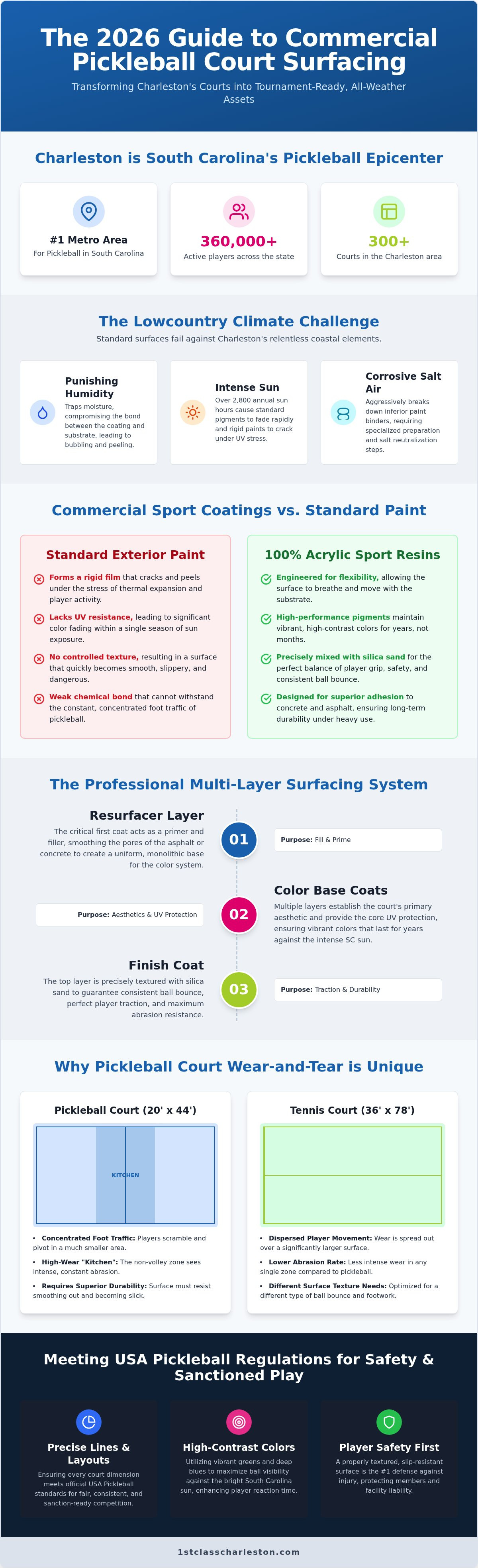
Don't let the smaller court size fool you. Because a pickleball court is only 20' x 44', foot traffic is much more concentrated than on a tennis court. Players pivot and scramble constantly in the non-volley zone, often called the "Kitchen." This creates intense wear patterns that standard exterior paints simply can't handle. High-use zones require superior abrasion resistance to prevent the surface from smoothing out and becoming slick over time. Additionally, the texture of the coating must be perfectly balanced. If it's too smooth, the ball skids; if it's too rough, it prematurely wears down equipment and shoes.
Meeting USA Pickleball Standards in South Carolina
Accuracy is everything in competitive play. USA Pickleball regulations require specific line widths and precise court layouts to ensure sanctioned play is fair and consistent. In the bright South Carolina sun, visibility becomes a major safety factor for players. We recommend choosing high-contrast colors, like deep blues or vibrant greens, to help players track the ball against the intense glare. Precision in the playing area matters because even a half-inch deviation can change the dynamics of a match. Investing in professional commercial pickleball court painting Charleston signals to your members that your facility takes their sport seriously and values their safety.
Commercial-Grade Sport Coatings vs. Standard Painting
Don't be tempted by the hardware store's "heavy-duty" porch paint. It's a common mistake that leads to costly repairs. Standard exterior paints are designed to sit on a vertical surface or a low-traffic walkway; they simply don't have the chemical bond required for an athletic court. Investing in professional commercial pickleball court painting Charleston ensures you're using a system built for the game. While house paint forms a rigid film that eventually cracks and peels, 100% acrylic sport resins are engineered to remain flexible. They move with the surface rather than fighting against it.
Charleston's climate is famously demanding. With over 2,800 annual sun hours, the UV exposure here is brutal. Standard pigments fade within a single season, leaving your court looking tired and washed out. Commercial-grade coatings utilize high-performance, UV-resistant pigments that maintain their vibrancy for years. Traction is the other critical factor. We incorporate specific grades of sub-angular silica sand into the mix. This provides the perfect balance of grip for quick pivots and "give" to protect players' joints. When we discuss protecting surfaces in coastal environments, we're talking about defending against salt air that aggressively breaks down inferior binders.
The Multi-Layer Surfacing Process
A professional finish isn't achieved in one pass. It's a strategic build-up. We start with the Resurfacer Layer, which acts as a primer and filler to smooth out the "pores" of the concrete or asphalt. Next comes the Color Base. This is where the primary aesthetic and UV protection are established. Finally, we apply the Finish Coat. This top layer is precisely textured to ensure a consistent ball bounce across the entire court. If your facility needs a surface that stands up to this heat, our team at 1st Class Painting & Restoration can provide the technical expertise your project requires.
Why Acrylic Coatings are Non-Negotiable
Acrylics are the industry standard for a reason. They handle thermal expansion beautifully. During Charleston heat waves, your court slab expands; at night, it contracts. Acrylic coatings are elastic enough to bridge these movements without blistering. Just as importantly, they allow for hydrostatic pressure relief. This means moisture vapor from the ground can pass through the coating without pushing it off the slab. It's a breathable shield. Acrylic Sport Surfacing is a specialized polymer system designed for athletic traction. Without this specific chemistry, your commercial pickleball court painting Charleston project won't survive the first humid summer.
Surface Preparation: Beating Charleston’s Humidity and Salt Air
Preparation is the soul of a 1st Class project. In Charleston, we don't just cover cracks; we fix the foundation. Many contractors treat court surfacing like a standard paint job, but commercial pickleball court painting Charleston requires a restoration-first mindset. Before a single drop of acrylic touches the ground, we conduct a thorough site assessment to distinguish between minor cosmetic blemishes and deep structural concerns. If the underlying slab is failing, the most expensive coating in the world won't save it. We believe in doing it right the first time so your facility doesn't face premature peeling or bubbling.
Salt air is a constant factor for our coastal properties. It's not enough to simply pressure wash the surface. We utilize specialized salt neutralization techniques to ensure the substrate is chemically clean. Without this step, microscopic salt crystals trapped under the coating will eventually pull moisture through the film, leading to total adhesion failure. For smooth concrete slabs, we often employ mechanical grinding or acid etching to "open" the pores of the material. This creates a profile that allows the multi-layered sport resins to bite into the surface, forming a permanent bond that withstands heavy tournament play.
The Lowcountry Climate Challenge
Humidity is our biggest hurdle. In Charleston, morning humidity often exceeds 90%, meaning the "Dew Point" is a critical calculation for our crews. We never start the application process before 10 AM. This ensures the morning moisture has fully evaporated and the surface temperature is rising. Timing is everything. We meticulously schedule our work around those unpredictable South Carolina afternoon thunderstorms. If a coating is caught in a downpour before it has properly cured, the entire layer can be compromised. We watch the skies so you don't have to.
Fixing 'Birdbaths' and Drainage Issues
Standing water is the absolute enemy of commercial court paint. We use the "1-inch rule" to identify birdbaths, which are low spots where water collects. Any depression that holds more than a nickel's depth of water after an hour of sun must be leveled. We apply specialized acrylic patch binders to fill these areas, ensuring the court maintains the industry-standard 1% slope for proper drainage. A flat, well-drained court dries faster after a storm, getting your members back into the game quickly and preventing the hydrostatic pressure that causes coatings to blister over time.
Commercial Solutions for HOAs, Clubs, and Municipalities
Communities thrive when shared spaces are vibrant and safe. For Charleston HOAs and athletic clubs, a court project is an investment in resident happiness and property value. Efficiency matters. We know that every day a court is closed is a day of missed play for your members. Our 5-step workflow for commercial pickleball court painting Charleston focuses on minimizing downtime without rushing the technical details. We move from structural assessment and salt neutralization to the final precision striping with a cadence that respects your facility's busy schedule.
Customization is a point of pride for many local clubs. We don't just offer standard colors. We can incorporate custom club logos or unique color schemes, such as the classic "Charleston Blue," to help your facility stand out. Beyond the initial application, we help you establish a maintenance schedule that can extend the life of your surface by 5+ years. Simple steps like regular debris clearing and annual soft-washing prevent the abrasive wear that breaks down acrylic resins. If you're ready to revitalize your community amenities, contact 1st Class Painting & Restoration to discuss your vision.
HOA and Property Manager Considerations
Property managers have a lot on their plate. Safety is always the top priority. Our high-traction finishes are designed to meet USA Pickleball standards, significantly reducing slip-and-fall risks for your residents. We also take the headache out of the logistics. Our team coordinates directly with your management to ensure residents are informed about noise and parking, making the process as smooth as the final serve. A premium coating doesn't just look better; it offers a higher long-term ROI by extending the time between expensive repainting cycles.
The Conversion Process: Tennis to Pickleball
Many Charleston facilities are repurposing underutilized space. Converting a single tennis court into two or even four pickleball courts is the most efficient way to handle the sport's massive growth. The process is methodical. First, we assess the existing tennis court's structural integrity to ensure it can handle the new layout. Second, we mechanically grind down the old tennis lines. This is a critical step to prevent "ghosting," where the old lines faint through the new coating. Finally, we lay out the new pickleball boundaries with surgical precision, ensuring maximum court density for your facility.
Why 1st Class is Charleston’s Premier Choice for Court Restoration
Results matter. In Charleston, your court is more than just a surface; it's a reflection of your community's standards. We've seen far too many facilities suffer because a contractor treated their court like a standard exterior wall. At 1st Class Painting & Restoration, we provide a unique fusion of high-end aesthetics and heavy-duty structural expertise. We don't just apply color. We restore the integrity of your slab. Our team understands that commercial pickleball court painting Charleston requires a meticulous approach that addresses the root causes of wear, not just the visible symptoms.
Local accountability is our hallmark. We are a Charleston-owned team that lives and plays in the same neighborhoods we serve. This means we have a personal stake in every project we complete. We understand how Lowcountry soil settles and how our salt-heavy air attempts to degrade even the toughest coatings. Because we know the climate, we never take shortcuts on preparation or material coats. We take personal honor in delivering a vibrant, durable surface that brings people together for years to come. Your success is our success.
A Trusted Advisor for Your Property
Experience is a powerful teacher. With 23 years of serving the Charleston community, we've refined our process to handle the specific technical demands of sport court surfacing. We believe in being a trusted advisor rather than just another vendor. This starts with transparent pricing and realistic timelines that respect your facility's operational needs. You'll never deal with a national call center or a detached project manager. You work directly with local craftsmen who care about the fine details, from the crispness of the lines to the consistency of the texture.
Get Your Commercial Court Estimate Today
Ready to revitalize your space? The process begins with a comprehensive site walk-through with our sport surfacing specialists. During this facility assessment, we'll identify any drainage issues, structural cracks, or surface contamination that could affect the longevity of your new coating. We provide a clear roadmap for your project, ensuring you know exactly what to expect from the first estimate to the final dink on your new court. Don't settle for a temporary fix when you can have a professional, tournament-ready finish. Transform your Charleston facility with 1st Class Painting & Restoration and see the difference that true local expertise makes for your community.
Elevate Your Facility with a Tournament-Ready Surface
Your court is the heart of your community. It's where neighbors meet and athletes compete. By choosing a specialized 100% acrylic resin system and prioritizing meticulous surface preparation, you ensure your facility stays vibrant and safe for years. The secret to a durable finish in the Lowcountry lies in managing our unique humidity and salt air through expert restoration. This approach prevents premature peeling and ensures your investment stands up to the intense South Carolina sun.
When you partner with a team that offers 23 years of local experience, you get more than just a fresh coat of color. You get the peace of mind that comes with a specialized sport surfacing team of licensed and insured professional painters. We take immense pride in our craft and our local community. If you're ready to transform your property with the highest standard of commercial pickleball court painting Charleston has to offer, we're here to guide you every step of the way.
Request a Commercial Pickleball Court Assessment
Let's build a space where your members love to play!
Frequently Asked Questions
How long does commercial pickleball court painting take in Charleston?
A typical project for commercial pickleball court painting Charleston usually takes between three and five consecutive days of clear weather. The first day focuses on deep cleaning and salt neutralization. Subsequent days involve applying the resurfacer and multiple color coats. We must allow proper curing time between layers. If Charleston's unpredictable afternoon thunderstorms interfere, we pause to protect the finish, ensuring the final result is durable and professional.
What is the best time of year to paint a sport court in South Carolina?
The ideal windows for court surfacing in the Lowcountry are the spring and fall months. During these periods, temperatures stay consistently between 50 and 90 degrees, which is the sweet spot for acrylic resins to bond correctly. While we work year round, the extreme humidity of July and August can complicate drying times. Scheduling your project in April or October often provides the most reliable weather for a seamless application.
Can you paint over an existing tennis court to make it a pickleball court?
Yes, converting underutilized tennis courts is a highly effective way to increase facility density. We start by mechanically grinding down the existing tennis lines to prevent "ghosting" after the new coat is applied. Once the surface is level and prepped, we lay out the new pickleball boundaries. This process allows a single tennis court space to accommodate up to four regulation pickleball courts, maximizing your property's recreational value.
How often should a commercial pickleball court be repainted?
Most high-traffic commercial courts require a fresh surfacing system every five to eight years. The lifespan depends heavily on the volume of play and your regular maintenance habits. Facilities that keep their courts clear of debris and perform annual soft-washes tend to see their coatings last much longer. If you notice the texture becoming smooth or the colors beginning to fade significantly, it's time to consider a professional refresh by a specialized team.
Are there specific 'official' colors required for pickleball courts?
There are no mandatory "official" colors required by USA Pickleball, but high-contrast schemes are strongly recommended for safety. Most Charleston facilities opt for a two-tone look, using a darker color like blue for the out-of-bounds area and a lighter green for the playing surface. This contrast helps players track the ball more easily in the bright coastal sun. We can also provide custom colors to match your club's specific branding or aesthetic.
Does the humidity in Charleston affect how the court paint dries?
Humidity is a major factor that dictates our daily workflow. High moisture levels in the air slow down the evaporation of water from the acrylic resins, which can delay the curing process. We use local weather data to monitor the dew point and ensure the surface is completely dry before applying any coatings. This meticulous attention to the Charleston climate prevents common issues like bubbling or poor adhesion that often plague less experienced contractors.
How do you handle cracks in the concrete before painting?
We utilize a restoration-first approach to address structural integrity before any commercial pickleball court painting Charleston begins. Our team cleans out all debris from the cracks and fills them with specialized acrylic crack patches. These materials are designed to expand and contract with the slab, which helps prevent the cracks from "telegraphing" through the new finish. For larger structural issues, we assess the foundation to ensure the repair provides a long-term solution.
Is the court surface slippery when wet?
A professionally finished court should provide excellent traction even in humid conditions. We mix specific grades of sub-angular silica sand into the final color coats to create a slip-resistant texture. This grit provides the grip players need for quick lateral movements while maintaining enough "give" to be comfortable on the joints. While we don't recommend playing on standing water, our surfaces are designed to meet rigorous safety standards for competitive athletic play.


