
Cost to Resurface Pickleball Court: Complete 2026 Buyer Guide
Discover the true cost to resurface pickleball court slabs in 2026. Compare acrylic systems, prep work, and contractor bids to build a durable court today.

The square footage of your playing area doesn't dictate your final investment; substrate integrity does. If you've gathered bids lately, you know how confusing it is to evaluate the true cost to resurface pickleball court slabs, especially when estimates swing wildly from one contractor to the next. It's deeply frustrating to watch fresh color blister, crack, or trap standing water just months after a cut-rate patch job.
A durable, regulation-grade court requires far more than rolling on an aesthetic topcoat. Especially in coastal climates, intense summer sun, driving rain, and rising ground moisture quickly degrade surfaces that lack proper preparation and specialized adhesion primers. You deserve an inviting, textured court engineered to endure thousands of hard-fought rallies without peeling under pressure.
This 2026 buyer guide breaks down the essential factors shaping your project, from multi-layer acrylic systems to critical moisture testing. We will provide a clear, repeatable framework so you can compare professional estimates and make an informed, long-term investment in your property.
Key Takeaways
- Substrate condition dictates your budget: Addressing structural cracks, low spots, and base preparation impacts the overall cost to resurface pickleball court slabs far more than cosmetic square footage alone.
- Sport-formulated coatings outperform paint: Regulation courts rely on multi-layer 100% acrylic resin systems blended with graded silica sand rather than standard exterior paints that wear slick and peel.
- Surface preparation protects your investment: Meticulous power washing, biological decontamination, and vapor transmission testing prevent premature blistering and recurring finish failures.
- Local climate dictates application success: Humid environments and intense sun exposure require careful scheduling around dew points and ground moisture to ensure proper acrylic curing.
- Specialized craftsmanship makes the difference: Choosing contractors with dedicated sport court experience, specialized squeegee application tools, and laser line striping ensures true ball bounce and lasting traction.
What Factors Determine the Cost to Resurface a Pickleball Court?
Every court tells a story. Some require a simple refresh, while others hide deep moisture issues and structural flaws beneath faded acrylic. When calculating the cost to resurface pickleball court surfaces, experienced contractors don't just eyeball square footage. Instead, a thorough evaluation balances three core elements: structural slab health, total square footage, and chosen coating systems. Evaluating these foundational components upfront prevents expensive surprises once pressure washers strip away oxidized top layers.
Court Dimensions, Playing Area, and Perimeter Sizing
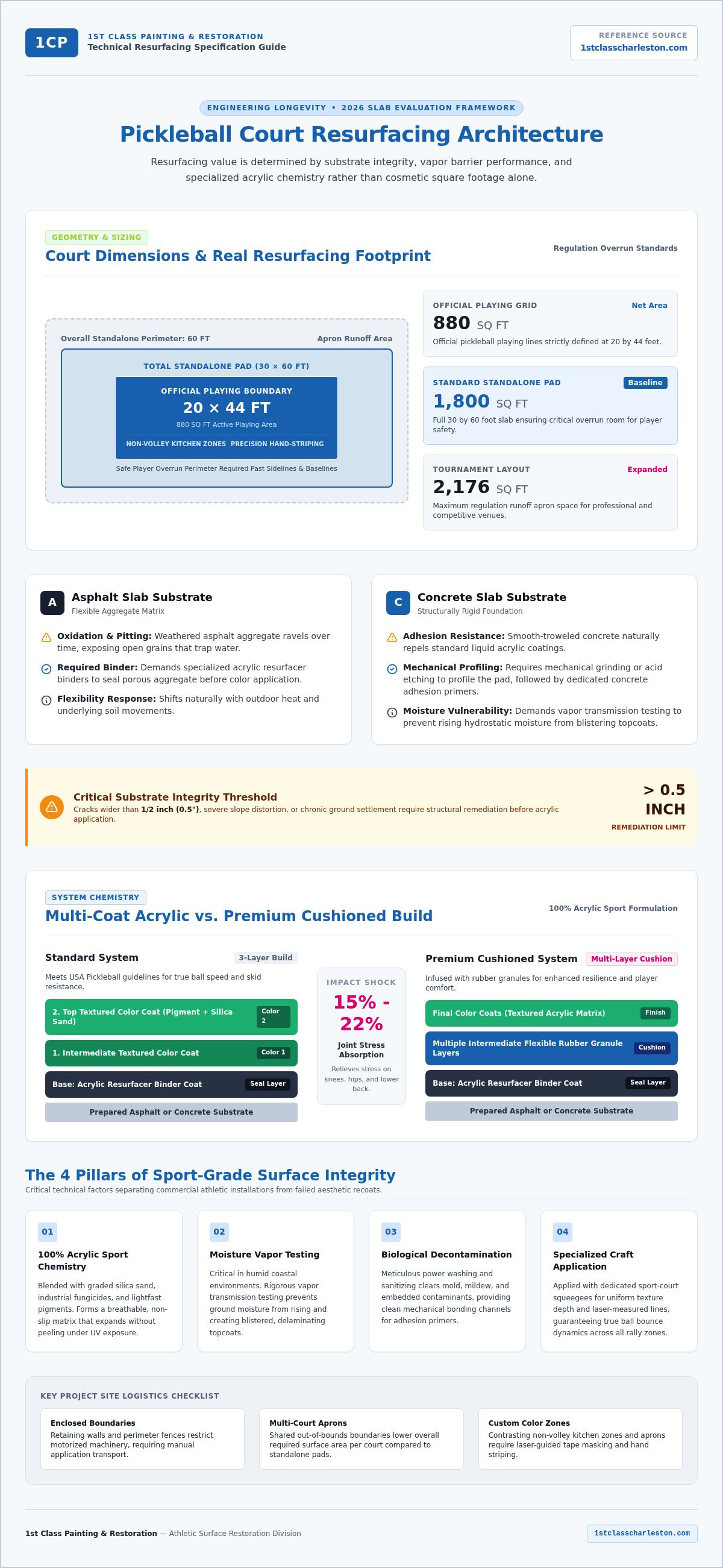
Geometry matters. While the official pickleball court dimensions dictate a playing boundary of 20 by 44 feet, the resurfacing area extends well past the sidelines. Players need safe overrun room. A standard standalone court requires an overall footprint of at least 30 by 60 feet, totaling roughly 1,800 square feet, while tournament-grade layouts often reach 2,176 square feet.
Site logistics also shape the overall scope:
- Enclosed boundaries: Tight perimeter fences and retaining walls restrict access, requiring manual transport rather than motorized equipment.
- Multi-court configurations: Grouped courts share out-of-bounds apron space, reducing total surface area per court compared to isolated standalone pads.
- Custom layout schemes: Blending vibrant kitchen zones with contrasting perimeter aprons requires meticulous masking and precision hand-striping.
Existing Slab Substrate: Asphalt vs. Concrete Dynamics
What sits beneath your feet makes or breaks surface longevity. Asphalt and concrete react differently to outdoor heat and settling soil, demanding tailored preparation techniques.
Asphalt slabs present a flexible, porous aggregate matrix. Over time, oxidized asphalt ravels and pits, requiring specialized acrylic resurfacer binders to seal the open grain before applying color coats. Concrete slabs, while structurally rigid, introduce unique chemical challenges. Smooth-troweled concrete naturally repels liquid acrylics. Technicians must mechanically grind or acid etch the pad to create an open profile, run moisture vapor tests, and apply dedicated concrete adhesion primers.
If a slab suffers chronic ground settlement, severe slope distortion, or structural cracks wider than a half-inch, simple liquid recoating won't hold. Structural remediation must precede surface finishing to safeguard your investment.
Comparing Pickleball Court Resurfacing Systems and Material Quality
Paint alone doesn't make a sport court. A common mistake property owners make is confusing everyday exterior porch paint or driveway sealers with athletic surface chemistries. True sport surfacing relies on high-grade, 100% acrylic resins formulated with specialized fillers, lightfast pigments, and industrial fungicides. These systems bond directly with the prepared substrate to form a breathable, non-slip matrix that expands and contracts under shifting weather conditions.
The coating system you select directly impacts your long-term cost to resurface pickleball court slabs. High-grade acrylics resist heavy foot scuffing, maintain vivid contrast under intense UV rays, and preserve true ball responsiveness across years of competitive play.
Standard Multi-Coat Acrylic vs. Premium Cushion Systems
Your choice between standard and cushioned acrylics comes down to play dynamics and player comfort. Standard systems typically consist of one acrylic resurfacer base coat followed by two textured color coats, meeting all USA Pickleball court construction guidelines for ball speed and reliable skid resistance. They offer excellent durability and represent a dependable baseline for most residential and neighborhood courts.
Premium cushioned systems, by contrast, incorporate multiple intermediate coats infused with flexible rubber granules before the final color application. This resilient cushion layer can absorb 15% to 22% of impact shock, easing stress on knees, hips, and lower backs. While these multi-layer builds require more material volume and extended application times, the enhanced joint relief makes them increasingly popular for senior living communities and active private clubs.
Silica Sand Grading and Surface Texture Control
Grip is everything on a fast kitchen volley. True athletic traction isn't created by rough concrete; it's engineered into the acrylic through carefully graded silica sand:
- Rounded grain geometry: Professional coatings use sub-angular or rounded quartz sand rather than angular blasting sand, preventing harsh shoe abrasion while preserving uniform ball bite.
- Precise mesh sizing: Aggregates typically range between 60 to 90 mesh, ensuring a consistent texture that avoids dead spots or erratic ball skips.
- Consistent suspension: Hand-stirred job site mixes often drop sand to the bottom, causing uneven wear. Specialized sport coatings ensure stable particle suspension during squeegee passes.
Choosing the right combination of cushion layers, vibrant UV-resistant pigments, and balanced aggregates takes seasoned craftsmanship. If you want help evaluating material systems tailored to your property, consulting with 1st Class Painting & Restoration ensures your surface is built to tournament standards.
Surface Preparation: The Invisible Factor in Total Project Cost
Skimping on preparation guarantees premature coating failure. Up to 60% of skilled labor on a high-performing court project happens before a single drop of color ever touches the ground. If an estimate seems surprisingly low, the contractor is likely rolling paint over contaminated concrete or unaddressed fractures. In reality, methodical prep work represents the largest variable in the overall cost to resurface pickleball court slabs, protecting your investment from bubbles, chips, and peeling.
Every restoration begins with high-pressure rotary washing to eliminate stubborn algae, grease, and chalking residue. Technicians then assess the bare slab for moisture vapor drive. Untreated moisture migrating upward through concrete forces acrylic coatings to blister, requiring specialized barrier primers before any leveling compounds are laid.
Birdbath Leveling and Drainage Remediation
Standing water kills acrylic bonds and creates slick safety hazards. Following American Sports Builders Association (ASBA) standards, a defect or "birdbath" exists if standing water deeper than 1/16 inch, roughly the thickness of a nickel, remains one hour after rain in 70-degree sunlight.
Eliminating these depressions requires patience and precision:
- Flood mapping: Technicians flood the court with water, outline persistent pools with chalk as they dry, and measure depth profiles.
- Multi-pass leveling: Low zones are patched with specialized acrylic binders fortified with Portland cement, applied in thin layers to avoid ridges.
- Edge feathering: Each patch is carefully sanded smooth so players never feel transitions underfoot or encounter irregular ball bounces.
Crack Repair Systems: Flexible Membranes vs. Structural Stitching
Concrete and asphalt naturally expand under summer heat and contract during winter cold snaps. Applying standard rigid hardware-store caulk to these fissures is a waste of effort; the filler ruptures within a single season. The specific nature of the fissure determines your preparation scope and long-term cost to resurface pickleball court foundations.
Hairline surface checks can be sealed using flexible acrylic fill compounds. Dynamic working cracks, however, require multi-layer stress-relief fabric membranes. These knitted systems bridge the joint, allowing the underlying slab to shift without breaking the color coat on top. If a slab exhibits vertical displacement or severe sub-base erosion, mechanical cross-stitching or subgrade leveling must occur before any surface membrane can succeed.
Environmental Challenges and Maintenance for Coastal Courts
Coastal geography introduces unique environmental stresses that inland courts rarely encounter. Intense solar radiation, airborne salt mist, and sudden tropical downpours test exterior coatings daily. In regions like the Lowcountry, high average humidity and annual rainfall accelerate organic fouling, promoting black mold and slick green algae growth across shaded playing surfaces. Understanding these regional variables helps you evaluate the true cost to resurface pickleball court slabs, ensuring your chosen materials are engineered for coastal longevity.
How Coastal Humidity and Salt Air Impact Coating Adhesion
Applying sport coatings in coastal environments requires careful timing. When relative humidity spikes, water-borne acrylic emulsions cannot evaporate properly, compromising the microscopic cross-linking needed for tough wear resistance. Slabs must also fall within strict surface temperature ranges, usually between 50°F and 120°F, meaning midsummer midday applications in direct Southern sunlight can cause coatings to cure prematurely on top while remaining soft underneath.
Salt air carries microscopic mineral crystals that settle onto playing surfaces, acting like fine sandpaper under athletic footwear. Heavy tree canopies from local live oaks and pines worsen surface wear by dropping acidic needles, staining leaves, and sap. Incorporating broad-spectrum biocide washes during initial prep prevents spores from blooming beneath new acrylic film layers.
Routine Maintenance to Protect Your Resurfacing Investment
Consistent care preserves your vibrant finish and protects the underlying investment. Simple, non-abrasive housekeeping routines keep high-traffic zones in tournament-ready condition:
- Weekly debris clearing: Remove loose grit, sand, and decomposing leaves with a commercial leaf blower or soft nylon broom before foot traffic grinds debris into the textured aggregate.
- Gentle washdowns: Rinse the court monthly using low-pressure garden hoses and mild, neutral-pH cleaners. Avoid harsh chlorine bleach washes or high-pressure turbo nozzles, which scour away graded silica sand.
- Baseline inspections: Check the non-volley zone and baseline pivot areas each spring to spot localized mechanical abrasion before moisture penetrates the binder.
When properly installed and cared for, outdoor sport surfaces deliver years of dependable play. To protect your playing surface against tough coastal weathering, schedule an on-site court evaluation with 1st Class Painting & Restoration today.
Hiring a Professional Sport Court Specialist in Charleston SC
Precision tools define true sports craftsmanship. Rolling out heavy acrylic resurfacers requires wide flexible neoprene squeegees, steady physical control, and specialized line-taping machines that guarantee razor-sharp edges. When you compare bids for the cost to resurface pickleball court facilities, remember that general house painters or weekend sealcoaters simply lack the specialized gear and athletic coating experience required for regulation-grade results.
Vetting local portfolios protects your investment against common amateur mistakes like ridged squeegee marks, wavy kitchen lines, and peeling aggregate. A transparent, itemized proposal should detail every phase, separating surface decontamination, birdbath leveling binders, crack isolation fabrics, base resurfacers, textured color coats, and regulation striping into clear, understandable line items.
Crucial Questions to Ask Every Sport Court Contractor
Protect your home or neighborhood community by asking targeted technical questions before signing any contract:
- Specialized experience: Can the contractor provide references and high-resolution photos of completed dedicated pickleball court painting projects?
- Substrate testing: How will their crew assess moisture vapor drive and relative slab humidity before laying base coats?
- Insurance and compliance: Do they hold active South Carolina contractor licensing, general liability insurance, and comprehensive workers' compensation coverage?
- Scope transparency: Does the quote clearly distinguish between simple cosmetic recoating and multi-layer structural crack repair?
Partnering with 1st Class Painting & Restoration for Exceptional Results
Local experience makes all the difference in coastal environments. With 23 years of dedicated Lowcountry craftsmanship, our team understands the unique balance of humidity, intense sun exposure, and substrate moisture found across Charleston properties. We take personal pride in every project, bringing deep material knowledge and meticulous attention to detail to every private backyard slab, residential development, and commercial recreational facility.
We believe every court should be a source of community pride, vibrant neighborhood energy, and lasting enjoyment. From comprehensive slab diagnostics to laser-guided USA Pickleball regulation lines, our skilled craftsmen deliver beautiful, durable courts engineered to thrive in coastal South Carolina. To discover the true cost to resurface pickleball court spaces on your property, connect with 1st Class Painting & Restoration today for your custom evaluation.
Bring Tournament Quality to Your Court Today
Investing in your recreation space pays dividends in community pride, player safety, and curb appeal. When planning your project, remember that the true cost to resurface pickleball court slabs hinges on resolving underlying substrate cracks, selecting multi-coat 100% acrylic systems, and applying reliable moisture barriers. Cutting corners on prep work leads to rapid peeling, but a meticulous, climate-conscious approach guarantees vibrant color and consistent ball bounce for seasons to come.
With 23 years of local Charleston painting and surface restoration experience, our locally owned team brings specialized application techniques built specifically for harsh Lowcountry humidity and coastal weather. Whether you manage an active neighborhood HOA facility or want to revitalize a private backyard court, we take personal pride in delivering lasting, regulation-grade results. Request your sport court consultation with 1st Class Painting & Restoration, and let's build an inviting court your players will cherish every single game!
Frequently Asked Questions
How often does an outdoor pickleball court need to be resurfaced?
Outdoor pickleball courts generally require professional resurfacing every four to eight years under standard play. In coastal Charleston, higher UV exposure, heavy summer rains, and active community play often tighten that maintenance cycle to every three to five years. Regular debris sweeping and gentle washing help maximize the lifespan of your acrylic topcoats before moisture degrades the underlying binder.
What is the difference between tennis court paint and pickleball court coatings?
Pickleball coatings require finer aggregate grading and higher scuff resistance compared to standard tennis finishes. Because pickleball involves rapid, localized foot movement around the kitchen line and uses a lightweight plastic ball rather than a felted tennis ball, the surface silica texture must be precisely balanced. This prevents erratic skids and excessive sole wear while preserving uniform ball bounce across the playing pad.
Can you convert an existing tennis court into multiple pickleball courts?
Yes, a standard 60-by-120-foot tennis court can comfortably accommodate up to four regulation pickleball courts. Converting an existing slab is substantially more economical than building new post-tension pads from scratch. The process involves power washing, leveling existing birdbaths, applying a fresh acrylic color scheme, and painting dedicated regulation boundary lines for the new court geometry.
How long does the pickleball court resurfacing process take to complete?
A standard pickleball court resurfacing project typically takes three to six working days, depending on slab preparation and local weather. Deep crack repairs and low-spot leveling require adequate curing time before applying acrylic resurfacers and color coats. Technicians monitor ambient conditions closely, allowing a final 48 to 72 hours for full surface curing before opening the court for aggressive competitive play.
Can cracks in an asphalt court be permanently eliminated through resurfacing?
Resurfacing alone cannot permanently eliminate structural cracks caused by ground settling or thermal cycles. While standard acrylic caulks re-open after a single winter, installing multi-layer knitted stress-relief membranes isolates underlying base movement for multiple seasons. Factoring engineered membrane repair into the total cost to resurface pickleball court slabs prevents reflective cracking from ruining your fresh color coat.
What weather conditions are required to properly apply acrylic court coatings?
Professional acrylic court coatings require dry weather with surface temperatures between 50°F and 120°F and relative humidity below 80%. In Charleston's humid climate, early morning dew and afternoon thunderstorms disrupt curing. Experienced crews schedule applications carefully during moderate spring and autumn windows to ensure the acrylic resins cross-link properly without trapping unwanted moisture beneath the film.
Why is standard exterior driveway sealer unsuitable for a pickleball court?
Standard driveway sealers use soft petroleum or coal-tar emulsions that soften in summer heat and turn dangerously slick when wet. They lack the graded silica aggregate and breathable polymer chemistry needed for athletic grip, ball responsiveness, and water vapor transmission. Using driveway sealer will compromise traction, ruin ball bounce, and ultimately escalate the eventual cost to resurface pickleball court slabs properly.


