
Exterior Trim Repair and Paint in Charleston: Complete Homeowner Guide
Master exterior trim repair and paint Charleston homes need to stop wood rot. Learn proper preparation, material selection, and coastal protection tips now.

A fresh coat of paint can't cure wood rot. In our humid Lowcountry climate, trapping moisture beneath a quick cosmetic patch only accelerates decay along your window casings, soffits, and fascia boards. To safeguard your home against the elements, the exterior trim repair and paint Charleston properties need must address structural moisture damage before opening a single can of paint.
Few things are more frustrating than watching fresh paint bubble and peel after just one humid summer, especially when past contractors simply painted over spongy timber. You deserve woodwork that endures coastal heat and driving rain without failing. In this guide, you'll discover how to identify hidden rot, choose proven materials that withstand maritime conditions, and hire dedicated local restoration craftsmen. We'll walk you through the essential inspection steps, smart material upgrades, and protective finish techniques that keep your exterior trim beautiful and sound for years to come.
Key Takeaways
- Learn how to detect hidden fungal decay lurking behind seemingly sound paint films before moisture compromises your home's framing.
- Evaluate whether targeted architectural epoxy consolidation or full board replacement is the best solution for your home's molding.
- Master the critical preparation steps, including bare wood moisture testing, required for long-lasting exterior trim repair and paint Charleston coastal conditions demand.
- Discover why hiring dual-trade craftsmen who handle both carpentry restoration and high-performance exterior painting prevents recurring trim failure.
Diagnosing Exterior Trim Damage in Charleston's Coastal Climate
Living along the South Carolina coast means your home contends with relentless humidity, salt air, and wind-driven subtropical storms. Wood reacts constantly to this damp environment. Charleston trim boards expand during stifling summer afternoons and contract as cooler evening breezes roll off the harbor. Over time, moisture slips behind exterior coatings, quietly feeding fungal decay while the outer paint surface remains deceptively smooth. Distinguishing cosmetic paint cracking from active rot is essential before undertaking any exterior trim repair and paint Charleston project, because painting over wet wood simply traps water and accelerates decay from the inside out.
Common Signs of Moisture Intrusion on Lowcountry Trim
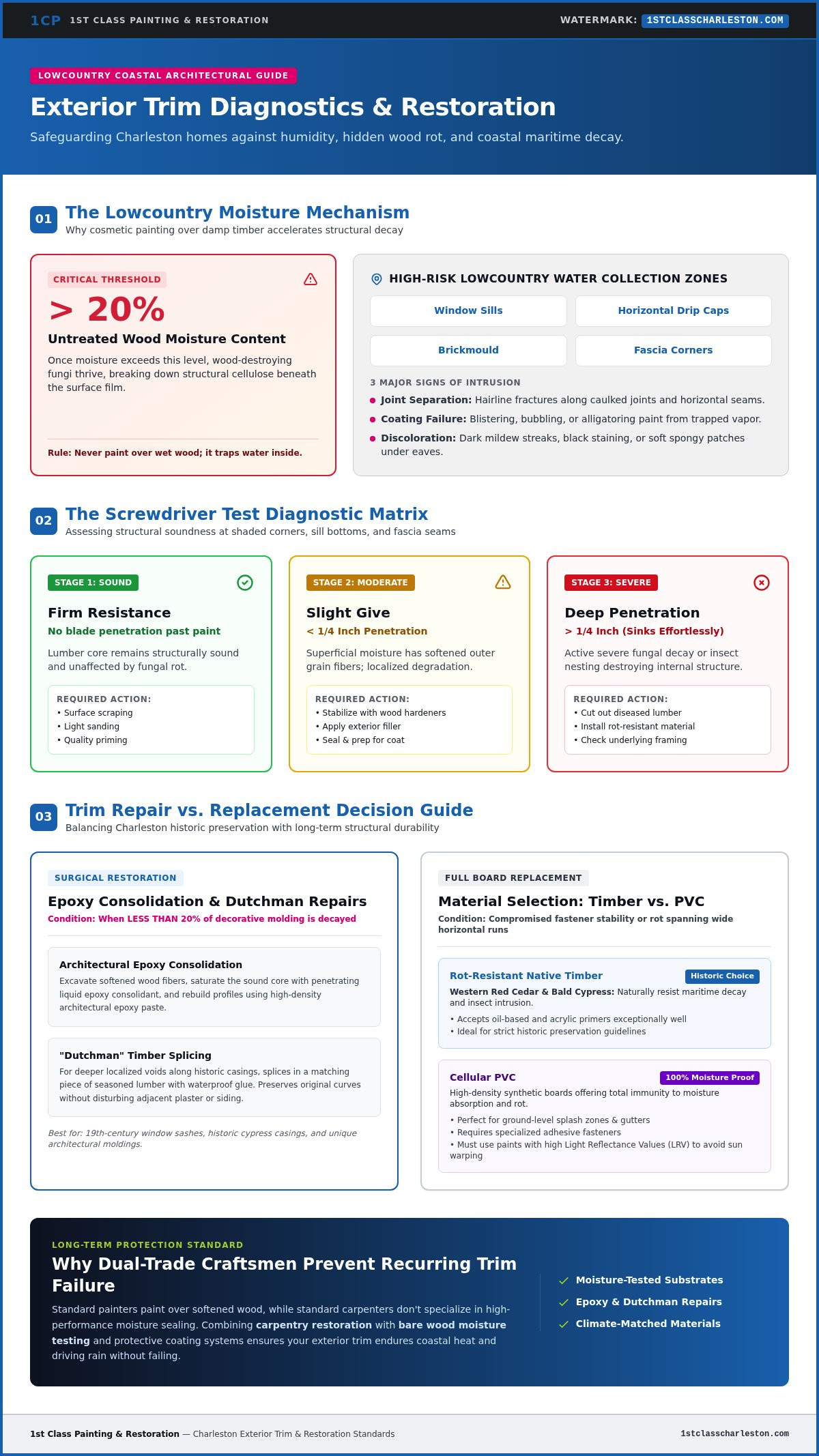
Look closely at the high-risk zones where water collects: window sills, horizontal drip caps, brickmould, and fascia corners. Common red flags include:
- Joint separation: Hairline fractures along caulked joints and horizontal seams where water seeps behind window casings.
- Coating failure: Blistering, bubbling, or alligatoring paint that signals trapped moisture vapor pushing through the film.
- Discoloration: Dark mildew streaks, black staining, or soft spongy patches underneath roof eaves and gutter lines.
Understanding traditional wood preservation techniques clarifies why these symptoms occur: once moisture content in untreated wood exceeds twenty percent, wood-destroying fungi thrive, breaking down structural cellulose beneath the surface.
The Screwdriver Test: Assessing Structural Soundness
How do you verify if suspect molding needs basic refinishing or carpentry replacement? Grab a simple flathead screwdriver. Press the tip firmly against shaded corners of your window aprons, sill bottoms, and fascia seams.
- Firm resistance: If the tip cannot penetrate beyond the paint film, the lumber remains structurally sound, requiring scraping, light sanding, and priming.
- Slight give (under 1/4 inch): Superficial moisture has softened the outer grain. This localized issue can often be stabilized with wood hardeners and exterior filler.
- Deep penetration (over 1/4 inch): The blade sinking effortlessly indicates severe fungal decay or insect nesting. In these cases, durable exterior trim repair and paint Charleston homes need demands cutting out the diseased lumber and installing rot-resistant replacements.
Trim Repair vs. Replacement: A Charleston Homeowner's Decision Guide
Every damaged board presents a crossroad. Do you surgically restore the existing timber or strip it down to the framing? In Charleston, the answer hinges on architectural significance, decay extent, and long-term exposure. Tearing off original 19th-century window sashes or historic cypress casings often destroys irreplaceable millwork that defines a home's character. Conversely, attempting to patch heavily rotted structural fascia boards with exterior putty simply wastes time. A strategic approach to exterior trim repair and paint Charleston properties require balances historic preservation with durable modern carpentry.
When to Choose Epoxy Consolidation and Dutchman Repairs
Consolidation works best when less than twenty percent of a decorative molding is decayed. Craftsmen excavate the softened wood fibers, saturate the sound core with a penetrating liquid epoxy consolidant, and rebuild the profile using high-density architectural epoxy paste. For deeper localized voids along historic casings, a "dutchman" repair splices in a matching piece of seasoned lumber with waterproof glue. This technique retains unique architectural curves without disturbing adjacent plaster, siding, or flashing.
Material Upgrades: Rot-Resistant Wood vs. Cellular PVC
Full board replacement becomes inevitable when rot compromises fastener stability or spans across wide horizontal runs. When replacing exterior trim, matching the material to its microclimate makes all the difference:
- Rot-resistant native timber: Western red cedar and bald cypress naturally resist maritime decay and insect intrusion. They accept oil-based and acrylic primers exceptionally well, making them ideal for historic districts where strict preservation guidelines apply.
- Cellular PVC: High-density synthetic boards offer complete immunity to moisture absorption and rot, making them perfect for ground-level splash zones or gutters. Keep in mind that PVC expands and contracts along its length in direct summer sun, requiring specialized adhesive fasteners and paints with high light reflectance values (LRV) to avoid warping.
Determining the right balance between synthetic longevity and historic authenticity requires seasoned eyes. Partnering with a skilled team like 1st Class Painting & Restoration ensures your carpentry updates honor architectural integrity while standing firm against coastal humidity.
The Essential Prep and Painting Process for Lasting Trim Protection
Quality finish coats are only as dependable as the foundation beneath them. Over eighty percent of coating failures stem directly from rushed surface preparation. In maritime South Carolina, taking shortcuts on substrate conditioning means repainting within twelve months. Achieving lasting durability in exterior trim repair and paint Charleston projects relies on an exact, step-by-step preparatory routine designed specifically for damp environments.
Mechanical Preparation and Moisture Verification
Begin by scraping failing paint away using sharp carbide pull scrapers, which bite cleanly into degraded layers without gouging healthy timber. Feather-sand transitions smooth so driving rain cannot catch on rigid paint edges. Before opening a can of primer, verify the lumber's internal moisture with a digital pin meter. Wood must register below fifteen percent moisture content. Coating timber above this threshold traps humidity inside, virtually guaranteeing bubbling and peeling once direct summer sunlight heats the surface.
Priming, Caulking, and Sealing Vulnerable Joints
Raw timber needs immediate stabilization against Lowcountry air. Apply a high-grade penetrating oil-based primer or premium bonding primer to lock down bare wood grain, paying special attention to cut end-grains where capillary action pulls water upward. Once the primer cures, seal seams using high-movement elastomeric polyurethane caulk:
- Bridge dynamic seams: Apply flexible sealant to vertical joints where trim meets siding, absorbing the natural expansion and contraction of seasonal temperature swings.
- Protect horizontal sills: Seal the perimeter of window casings where pooling rainwater commonly attacks fasteners.
- Leave weep holes open: Never seal the horizontal gap under drip caps or below window sill edges. Trapped moisture requires an unobstructed exit point to drain safely away from structural wall studs.
Selecting Durable Topcoats for Humid Environments
Finish the woodwork with two continuous coats of premium 100 percent acrylic latex exterior enamel. This formulation retains long-term flexibility, stretching and contracting across coastal temperature shifts without cracking. Opt for a satin or semi-gloss sheen; these lustrous finishes shed driving rain effectively and make it difficult for airborne mildew spores to take root. Respecting manufacturer dry times between applications ensures a tough, weather-resistant barrier, completing the reliable exterior trim repair and paint Charleston residences require to look stunning year after year.
How to Evaluate Exterior Trim and Painting Contractors in Charleston
Hiring the right team shouldn't feel like a gamble. Too many homeowners find themselves trapped between two separate trades: a carpenter who leaves bare wood exposed to the elements, and a painter who happily coats over active decay. Coordinating independent contractors creates scheduling delays, misaligned warranties, and finger-pointing when a joint opens up months later. To protect your investment, the exterior trim repair and paint Charleston properties need should be handled by a single crew skilled in both structural carpentry and precision finishing.
Key Questions to Ask Prospective Charleston Painters
Before signing a contract, interview candidates thoroughly to ensure they understand Lowcountry microclimates. Ask these direct questions:
- "Do your painters handle structural rot repairs directly?" Ensure the crew possesses finish-carpentry skills to replace framing, sills, and brickmould without halting work to call an outside sub-contractor.
- "How do you test wood moisture before applying primer?" Reputable contractors carry digital moisture meters on their trucks and document readings before priming.
- "What specific caulk and primer systems do you specify for coastal exteriors?" Listen for commercial-grade elastomeric sealants and exterior bonding primers rather than generic multipurpose products.
- "Can you provide proof of South Carolina licensing, general liability, and active workers' compensation insurance?" Always verify that coverage is active across Charleston County and surrounding municipalities.
Red Flags in Exterior Painting and Repair Estimates
Be cautious of vague, one-page estimates that simply state "prep and paint trim." True architectural restoration requires detailed scope documentation. If a contractor suggests covering spongy timber with bondo or standard spackle, show them the door. Purely cosmetic fixes trap water inside, guaranteeing that dry rot spreads deeper into your wall framing. Similarly, walk away from bids that fail to itemize carbide scraping, end-grain priming, or fastener replacement.
Ready to skip the headaches of managing separate trade crews? Schedule a trim evaluation with 1st Class Painting & Restoration to partner with experienced local craftsmen who manage your architectural carpentry and exterior painting seamlessly from start to finish.
Restoring Your Home's Curb Appeal with 1st Class Painting & Restoration
Restoring weathered woodwork requires more than surface brushwork. It calls for dedicated Lowcountry craftsmen who treat your property with genuine care and architectural respect. With 23 years of local experience, 1st Class Painting & Restoration resolves the underlying moisture rot and coastal weathering that challenge Charleston homeowners. Delivering high-caliber exterior trim repair and paint Charleston homes need to withstand maritime elements, our team restores structural integrity while reviving your property's authentic Southern charm.
The 1st Class Difference: Carpentry Meets Fine Finishing
Why juggle separate carpentry crews and house painters? Coordinating multiple contractors usually leads to miscommunication, scheduling bottlenecks, and unexpected finger-pointing. As an integrated team, our local craftsmen manage the entire journey from structural rot removal to precision finish painting. We handle the critical details that others overlook:
- Custom profile matching: We replicate historic moldings and modern architectural profiles so new sections blend invisibly with existing woodwork.
- Comprehensive back-priming: Every single replacement board is sealed on all six sides prior to installation, stopping moisture intrusion from behind.
- Lowcountry-tested finishes: We apply commercial-grade elastomeric caulks and high-elasticity acrylic coatings designed to resist coastal mildew, high humidity, and intense summer sun.
Start Your Exterior Trim Restoration in Charleston
Delayed repairs only allow coastal rot to spread deeper into your home's structural framing and wall studs. Addressing damaged trim now protects your investment, elevates curb appeal, and provides lasting peace of mind every time subtropical storms roll through. When you are ready for professional, long-lasting exterior trim repair and paint Charleston craftsmen stand behind, connect with 1st Class Painting & Restoration to schedule an in-depth on-site trim inspection and bring lasting beauty back to your exterior woodwork.
Protect Your Lowcountry Home with Lasting Trim Craftsmanship
Caring for a coastal home is a labor of love. When you take the time to diagnose hidden moisture, select rot-resistant materials, and prepare every surface with precision, your exterior woodwork can withstand anything the Atlantic throws its way. Quality exterior trim repair and paint Charleston homeowners rely on isn't just about sharp lines; it's about safeguarding the architectural character and structural health of your property.
You don't have to navigate carpentry repairs and protective coatings on your own. With 23 years serving Charleston and the Lowcountry, our craftsmen bring specialized knowledge of coastal humidity management directly to your project. We handle the complete process in-house, eliminating the stress of juggling multiple contractors so you can enjoy flawless, weather-tight results. Ready to elevate your curb appeal and protect your investment? Protect your home with Charleston's exterior trim experts at 1st Class Painting & Restoration today and enjoy true peace of mind through every storm season!
Frequently Asked Questions
How do I know if my exterior trim needs replacement or just paint?
You need replacement if wood yields deeply to physical pressure, while paint alone suffices if the underlying lumber remains solid and dry. Press a firm tool against suspect corners, joints, and sills. If the wood feels spongy or crumbles beyond a quarter-inch, structural decay has taken hold. If the surface resists pressure and only displays flaking, chalking, or hairline paint cracks, thorough mechanical scraping, priming, and repainting will restore it completely.
Can exterior painters repair rotted wood trim, or do I need a carpenter?
Many general painters only handle cosmetic coating, but true restoration specialists provide in-house carpentry alongside professional painting. Hiring separate trades often creates finger-pointing if joints open or water intrudes later. Choosing a company skilled in complete exterior trim repair and paint Charleston properties require ensures that diseased boards, soffits, and window sills are structurally replaced or epoxied before any paint is applied, protecting your warranty and investment.
What type of exterior paint finish is best for trim in Charleston?
Satin and semi-gloss sheens formulated in 100 percent acrylic latex perform best on Lowcountry exterior trim. Glossier finishes create a slick, tighter surface tension that sheds torrential coastal rains and resists mildew growth far better than flat finishes. Premium acrylic latex formulas also provide the necessary flexibility to expand and contract during extreme summer heat and humidity shifts, preventing premature cracking along intricate architectural profiles.
Why does exterior trim paint peel faster in the Lowcountry?
Relentless ambient humidity, intense UV radiation, and salt air drive rapid coating failure across coastal South Carolina. Charleston's high humidity causes bare wood to swell with trapped moisture vapor. When direct sunlight beats down on exterior trim, that trapped moisture attempts to escape outward, pushing against rigid paint films and causing blistered, peeling pockets. Without proper end-grain sealing and breathable, flexible primers, coatings simply cannot withstand our coastal climate.
What is cellular PVC trim, and is it a good choice for coastal homes?
Cellular PVC is a high-density synthetic composite board that completely resists rot, making it an excellent choice for moisture-prone coastal trim. Because it absorbs zero water, cellular PVC will never decay, warp from rain, or attract wood-boring insects around low-lying splash zones. However, it expands lengthwise in hot sun, requiring professional fastening techniques and topcoats formulated with light-reflective pigments to prevent heat distortion over time.
How often should exterior trim be repainted in Charleston, South Carolina?
Exterior trim in Charleston typically requires repainting every five to seven years, though high-exposure elevations may need attention sooner. South-facing walls and seaside elevations endure continuous UV degradation and wind-driven rain, accelerating wear along vulnerable horizontal moldings. Conducting annual visual checks and catching hairline caulking cracks early extends the lifespan of your exterior trim repair and paint Charleston project, keeping maintenance manageable while preserving your home's historic charm.
Will painting over rotted wood stop the rot from spreading?
No, painting over rotted wood actually accelerates decay by trapping moisture and fungal spores inside the timber. Wood rot is an active fungal infection that requires moisture and oxygen to thrive. Sealing rotted boards with fresh paint creates an incubator beneath the film, allowing fungi to consume the timber from the inside out until it reaches structural wall studs. Decay must always be physically excised or chemically consolidated before painting.


