
Historic Home Exterior Painting in Charleston, SC: The Preservation Guide
Navigate BAR rules for historic home exterior painting Charleston SC. Our guide covers approved colors, wood rot repair & avoiding fines for a lasting restor...

Five hundred dollars. That is the potential daily fine for unapproved exterior work in our city's historic districts. We understand the deep pride you feel for your property's heritage, but we also know the stress that comes with its upkeep. Between the strict Board of Architectural Review (BAR) standards and the relentless Lowcountry humidity, historic home exterior painting Charleston SC is a project that demands more than just a brush. It requires a preservation mindset. You want a home that stands as a testament to history, not a source of regulatory headaches.
This guide is your roadmap to a beautiful, compliant restoration. You'll learn how to navigate the 2026 BAR application process, including the $345 zoning and application review fee, while ensuring your property remains protected against salt air and wood rot. We will cover the specific color palettes approved for this year, from the classic Single House staples to the vibrant hues of Rainbow Row. By the end of this article, you will have the confidence to preserve your home's legacy with long-lasting, professional results!
Key Takeaways
- Understand how Charleston’s intense humidity and salt spray affect pre-1950s wood and why specialized restoration is required for longevity.
- Master the Board of Architectural Review (BAR) guidelines to ensure your project stays compliant while avoiding common regulatory pitfalls.
- Discover the "Restoration-First" approach that prioritizes meticulous wood rot repair to protect your home's structural integrity.
- Learn to select high-performance coatings and BAR-approved colors that resist the harsh coastal environment without sacrificing historical accuracy.
- See how professional historic home exterior painting Charleston SC can revitalize your property's appearance and significantly boost its market value.
The Unique Challenges of Historic Exterior Painting in Charleston
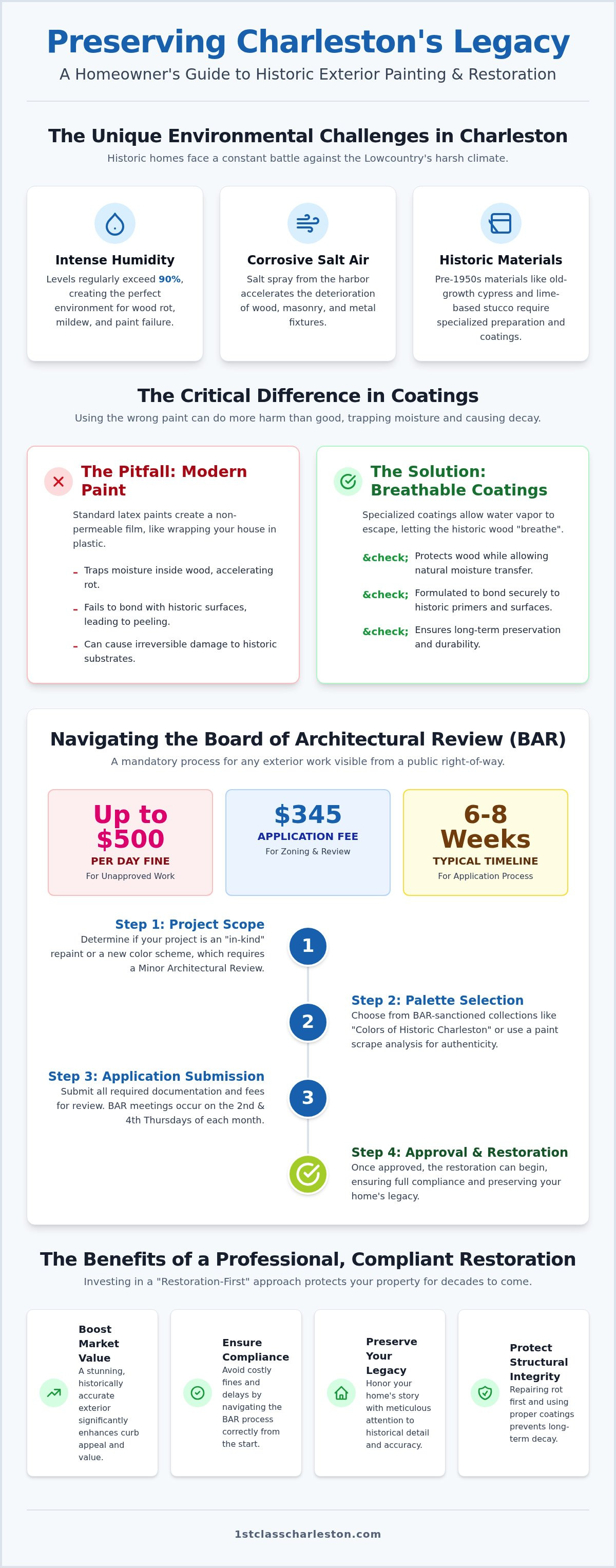
Preservation. It's more than just a fresh coat of color. When we talk about historic home exterior painting Charleston SC, we aren't just discussing aesthetics. We're talking about a specialized branch of restoration that deals with materials used before 1950. These structures within the Charleston Historic District face unique environmental pressures. Our local microclimate is beautiful, but it's brutal on old wood. Salt spray from the harbor and humidity levels that regularly top 90% create a constant battle against decay. This is why standard painting methods don't work for historic home exterior painting Charleston SC projects.
Modern, off-the-shelf latex paints are designed for new construction, not 200-year-old siding. If you apply a standard film-forming paint over historic lime-washed or oil-based surfaces, it won't bond. It will peel within months. Even worse, many modern coatings act like a plastic wrap, trapping moisture inside the wood. Historic coatings must be "breathable," allowing water vapor to escape so the substrate doesn't rot from the inside out. Without this permeability, the very paint meant to protect your home can actually accelerate its decline.
Understanding Historic Substrates: Cypress, Pine, and Stucco
Old-growth cypress and heart pine are incredibly dense. They require specific primer penetration to create a lasting bond. If a painter uses a fast-drying modern primer, it sits on the surface rather than soaking into the fibers. This leads to premature failure. We also see this with masonry; while modern EIFS is a synthetic cladding system that relies on a drainage plane, historic stucco is a solid, lime-based material that must remain permeable to manage the Lowcountry's relentless moisture. Trapping moisture behind non-breathable modern membranes is a recipe for structural disaster.
The Legacy of the Charleston Single House
The iconic Charleston Single House is a masterpiece of passive cooling, but its design presents specific painting challenges. Broad piazzas and intricate detailing require a meticulous hand to prevent moisture from pooling in joints. Orientation matters, too. South-facing walls endure intense sun-bleaching, while shaded north-facing piazzas are breeding grounds for mildew. We take great pride in preserving traditions like "haint blue" on porch ceilings, using authentic, high-quality finishes that honor the past while standing up to today's climate. It's about more than the look; it's about the legacy!
Navigating the Board of Architectural Review (BAR) Process
The BAR is the gatekeeper of our city's visual legacy. They protect the aesthetic integrity of nearly 4,800 structures that define the peninsula. For homeowners, this means that every brushstroke visible from a public right-of-way requires a stamp of approval. It isn't just about red tape; it's about ensuring your home remains a cohesive part of a 300-year-old story. We see the BAR as a partner in preservation, but we also understand that the application process can feel daunting for the uninitiated.
Most historic home exterior painting Charleston SC projects fall under the jurisdiction of the BAR-Small (BAR-S) or a staff-level review. Staff reviews are typically for "in-kind" repainting, where you are using the exact same colors already approved. If you're planning a change, you'll likely need a Minor Architectural Review. This involves presenting your proposed palette to the board during their meetings, which occur on the second and fourth Thursdays of each month. Don't let the "minor" label fool you. The board is meticulous about historical accuracy, and unapproved work can result in fines of up to $500 per day.
Charleston’s Historic Color Palettes
Choosing a color isn't as simple as visiting a hardware store. The city relies on officially sanctioned collections, such as the "Colors of Historic Charleston" by Sherwin-Williams. These shades are based on Colonial, Federal, and Greek Revival precedents. When selecting your body and trim colors, we also consider the Light Reflectance Value (LRV). In our dense urban environment, how a color reflects sun impacts both your home's temperature and the visual comfort of your neighbors. For those seeking the ultimate in authenticity, we can perform a "paint scrape" analysis. This process carefully removes layers of old paint to reveal the original 18th or 19th-century hue hidden beneath centuries of history.
The Approval Timeline and Documentation
Patience is a virtue in the Historic District. The application process typically takes 6 to 8 weeks, and there is a $345 zoning and application review fee collected by the city. To avoid delays, your submission must be perfect. This includes site photographs, color samples, and technical specifications of the materials. Because the board prioritizes repair over replacement, you must demonstrate a clear plan for surface preparation. This is where Partnering with a Charleston Historic Preservation Specialist becomes essential. We provide the technical data the board needs to see, ensuring your project moves from the agenda to the job site without unnecessary friction. If you're feeling overwhelmed by the paperwork, our team at 1st Class Painting & Restoration is here to guide you through every step!
Restoration vs. Repainting: Why Surface Prep is Non-Negotiable
Restoration. It's the difference between a cosmetic fix and a lasting legacy. When dealing with historic home exterior painting Charleston SC, the "restoration-first" philosophy isn't just a preference; it's a necessity. We believe that a fresh coat of paint is only as durable as the wood beneath it. If you apply high-quality coatings over damp or decaying fibers, you're merely hiding a structural disaster that will eventually bubble and peel. True preservation begins by looking past the surface to ensure the bones of your home are sound.
Many contractors reach for a pressure washer to speed up the cleaning process. On a 19th-century home, this is often a catastrophic mistake. High-pressure water can gouge soft, old-growth cypress or blast out historic lime mortar that has survived for centuries. It also forces moisture deep into the wood grain, requiring weeks of drying time before paint can be applied. Our team at 1st Class Painting & Restoration takes a different path. We rely on meticulous hand-scraping and sanding to remove failed coatings. This labor-intensive method allows us to feel the condition of the wood and identify issues that a machine would simply skip over.
Identifying and Fixing Lowcountry Wood Rot
In our humid climate, certain areas are ground zero for decay. We pay close attention to window sills, porch decks, and decorative corbels where water tends to pool. When we find damage, we don't just patch it with wood filler. We use advanced epoxy consolidants to stabilize soft areas or perform full timber replacements for structural integrity. 1st Class Painting & Restoration prioritizes matching original wood profiles to ensure every repair is invisible to the eye and faithful to the home's history. This level of detail is what keeps a Charleston single house standing strong against the elements!
Lead-Safe Work Practices
Safety is just as important as aesthetics. Since most historic homes in the peninsula were built well before 1978, they likely contain lead-based paint. Handling these materials requires more than just a mask; it requires RRP (Renovation, Repair, and Painting) certification. We follow strict federal guidelines to ensure that lead dust never enters your home or the local environment. Our containment strategies include heavy-duty plastic sheeting and HEPA-filtered vacuums to protect your Charleston garden and piazza during the prep phase. We treat your property with the same respect we'd show a museum, ensuring the restoration process is safe for your family and the community.
Selecting the Right Palettes and Products for the Lowcountry
Precision. That is what separates a standard job from a restoration project. When performing historic home exterior painting Charleston SC, selecting the right product is just as critical as the prep work we discussed earlier. In our coastal environment, the sheen of your paint isn't just a style choice; it's a defensive layer. High-gloss finishes are often preferred for trim and shutters because their slick surface sheds salt air and grime more efficiently than satin or flat options. This prevents the abrasive salt from "eating" into the finish over time.
We also have to account for our intense southern sun. The iconic "Charleston Green" is famous for its depth, but without modern UV-resistant additives, those dark pigments absorb heat and fade to a dull grey within a few seasons. We utilize 21st-century chemical durability to ensure these traditional aesthetics last for a decade, not just a year. For historic masonry and stucco, we often recommend modern elastomeric coatings. These specialized products bridge small hairline cracks and move with the building during our frequent temperature swings, providing a waterproof barrier that still allows the structure to "breathe."
The Science of Mildew Resistance
Charleston's lush gardens and narrow alleys create perfect pockets of shade and stagnant humidity. This is a breeding ground for biological growth. To combat this, we select paints with advanced antimicrobial properties that actively inhibit the growth of mold and mildew. Some modern "self-cleaning" technologies even use sunlight to break down organic matter on the surface, ensuring your home stays pristine despite the urban environment's dust and pollen!
Authentic Finishes: Lime Wash and Mineral Paints
For the most authentic "aged" Charleston look, traditional lime wash remains a top choice for brick. It provides that beautiful, mottled patina that only gets better with time. However, if you want superior longevity on historic brick, silicate-based mineral paints are the gold standard. Unlike latex, which sits on top of the surface, mineral paints chemically bond with the masonry. This creates a finish that is incredibly durable and highly permeable. It prevents interior dampness by allowing moisture to evaporate freely through the walls.
Ready to choose the perfect protection for your property? Contact the experts at 1st Class Painting & Restoration for a consultation today!
Partnering with a Charleston Historic Preservation Specialist
Local roots matter. They represent stability. When you choose a team for historic home exterior painting Charleston SC, you aren't just hiring people with brushes. You are inviting craftsmen into your home's story. 1st Class Painting & Restoration is locally owned and operated. We've spent 23 years working on the very streets you walk every day. We understand the weight of a BAR deadline and the specific way our coastal air settles into old cypress siding. This isn't just a business for us; it's a commitment to our community's standard of living.
We believe in neighborly warmth. What does that mean for you? It means clear communication from the first phone call to the final walkthrough. It means a deep respect for your property, your gardens, and your neighbors. When performing historic home exterior painting Charleston SC, we prioritize your emotional well-being by keeping the job site tidy and the process transparent. Our team bridges the gap between simple painting and comprehensive restoration, ensuring your home isn't just beautiful today but protected for decades. Why settle for a transactional relationship when you can have a trusted advisor?
Beyond the Brush: Full-Service Restoration
A historic home is a living thing. Often, an exterior project reveals the need for interior attention. Are your window sills showing age? Is it time to revitalize the heart of your home? We offer a holistic approach to maintenance that saves you the headache of managing multiple contractors. By integrating your exterior needs with interior updates, you ensure a cohesive aesthetic and structural health throughout the property. You can Explore our Kitchen and Bathroom Remodeling services to see how we bring the same meticulous care to your indoor spaces.
Requesting Your Historic Home Estimate
What should you expect during a specialized historic exterior consultation? We don't just glance at the walls and hand you a number. Our process is thorough. We inspect for wood rot, check the condition of previous coatings, and discuss your goals for BAR compliance. You will receive a detailed, transparent quote that accounts for the complexities of restoration work. No hidden fees. No surprises. Just honest, professional guidance. Are you ready to see your home transformed? We invite you to Schedule your professional consultation with 1st Class Painting & Restoration today. Let's preserve your legacy together!
Preserving the Soul of Your Charleston Home
Your property is more than a structure; it's a piece of our city's living history. Balancing the strict requirements of the BAR with the technical demands of a 90% humidity climate is no small feat. By embracing a restoration-first philosophy and selecting authentic, high-performance coatings, you're doing more than just maintaining a building. You're safeguarding a legacy for the next generation! Successful historic home exterior painting Charleston SC requires a partner who respects the past as much as they value the future.
1st Class Painting & Restoration brings 23 years of local expertise to every project. We're locally owned and operated, specializing in the delicate wood rot repair and preservation techniques that Charleston's unique architecture requires. We take immense pride in being your trusted guide through the complexities of historic maintenance. Our goal is to ensure your home remains a source of joy and a testament to the Lowcountry's enduring beauty.
Are you ready to revitalize your home's exterior with confidence? Get Your Free Historic Restoration Estimate today. Let's work together to make your home shine!
Frequently Asked Questions
Do I need BAR approval just to repaint my house the same color?
Yes, any exterior change visible from a public right-of-way requires review. For historic home exterior painting Charleston SC projects where you use the exact same color, the process is often a faster staff-level review. However, you must still submit the application and pay the required city fees. Don't skip this step! Failing to get approval can lead to significant daily fines and legal headaches that disrupt your preservation efforts.
How much does historic home exterior painting cost in Charleston?
The investment for historic home exterior painting Charleston SC varies based on the size of your property and the amount of restoration required. Factors like wood rot repair, lead paint stabilization, and the complexity of architectural detailing all influence the final quote. Because every historic structure has a unique story and set of needs, we provide detailed consultations to ensure your estimate reflects the specific care your home deserves.
What is the best time of year to paint my house in South Carolina?
Spring and fall offer the most reliable conditions for exterior work in the Lowcountry. During these months, humidity levels are more manageable and temperatures stay within the ideal range for paint to cure properly. We avoid the peak summer heat when afternoon thunderstorms and 90% humidity can interfere with the drying process. Planning your project during these temperate windows ensures a more durable finish and a smoother workflow for our craftsmen!
Can you repair wood rot instead of replacing the entire board?
Yes, we can often save original historic timber through specialized restoration techniques. If the decay is localized, we use high-grade epoxy consolidants to stabilize and rebuild the wood fibers. This approach preserves the home's authentic materials while restoring structural integrity. However, if the rot is extensive, we perform a full timber replacement using matching wood profiles. We always prioritize the method that best protects your home's long-term health and historical value.
How long does a professional exterior paint job last in Charleston humidity?
A high-quality paint job in our coastal environment typically lasts between five and seven years. The intense UV rays, salt air, and constant moisture in Charleston are much harder on finishes than in other regions. Using premium, breathable products and performing meticulous surface preparation are the best ways to extend this lifespan. Regular maintenance, such as soft washing to remove salt buildup, also helps keep your home's exterior looking vibrant and fresh!
Are there specific colors I must use in the Charleston Historic District?
Yes, the Board of Architectural Review (BAR) requires the use of historically accurate palettes. These collections are based on documented colors from the 18th and 19th centuries, such as the "Colors of Historic Charleston" series. While you have many beautiful options, from soft pastels to deep greens, they must be approved before work begins. We help you navigate these choices to find a shade that honors tradition while reflecting your personal style.
What is "Haint Blue" and why is it used on Charleston porches?
Haint Blue is a deeply rooted Lowcountry tradition found on the ceilings of many historic piazzas. Originally, the Gullah Geechee people believed this specific shade of blue would ward off "haints," or restless spirits, by mimicking the sky or water. Beyond the folklore, it serves a practical purpose by making the porch feel brighter and more airy. It's a quintessential Charleston detail that adds both a touch of mystery and timeless elegance to your home's exterior!
Is 1st Class Painting & Restoration lead-safe certified?
Yes, we are fully committed to lead-safe work practices on every project. Because we specialize in homes built before 1978, we strictly follow federal RRP (Renovation, Repair, and Painting) guidelines to protect your family and our community. Our team uses advanced containment and HEPA-filtered cleanup methods to ensure that lead dust is never a concern. With 23 years of local experience, we have the expertise to handle these sensitive materials with absolute care and professionalism.


