
HOA Exterior Painting Guidelines in South Carolina: A Homeowner Checklist
Learn HOA exterior painting guidelines South Carolina homeowners must follow. Use our checklist to get fast approval, avoid fines, and hire the right painter.

What if the color you love isn’t the part of your exterior painting request that determines approval? In South Carolina, HOA exterior painting guidelines can cover more than color. They may specify the review process, approved finishes, materials, and how the work should be completed. Checking those details before choosing paint or scheduling a contractor can help you avoid delays and unplanned work.
Requirements vary by community, and a neighbor’s paint color may not show what your HOA currently allows. Before settling on a palette, find the rules that apply to your property and confirm how the association reviews requests.
This checklist explains where to find the controlling documents, how to confirm the application process, and what to include in a well-documented request. You’ll also learn how to describe colors, finishes, surfaces, preparation, and project scope clearly, then choose a painter once approval requirements are understood. A little preparation can help your plans fit your community’s standards.
Key Takeaways
- Use your community’s governing documents to identify which rules control exterior paint choices and whether separate local requirements may apply.
- HOA exterior painting guidelines South Carolina communities follow can vary, so check approved colors, finishes, and property-specific conditions before choosing paint.
- Prepare a clear request with proposed colors, finishes, surfaces, preparation details, and any product information your association requires.
- Keep copies of your application, communications, decision, and approved project details for reference as the work progresses.
- Choose a painter after approval, share the written decision, and confirm the planned work matches its terms.
HOA Exterior Painting Guidelines in South Carolina: What Rules Actually Control?
Before choosing a color, find out which rules apply to your property. HOA exterior painting guidelines South Carolina homeowners must follow are community-specific requirements, usually set out in governing documents and architectural-review procedures. They may cover repainting, color changes, finishes, materials, or other exterior changes.
Keep three questions separate: Does your association require approval? Does current state law affect the issue? Does a local government or historic-preservation authority have a separate review requirement? An HOA decision addresses the association’s process; it doesn’t automatically answer whether public approval is needed. A Homeowner's Association (HOA) is a private community organization, but the specific authority and process affecting your home should be checked in the documents that apply to your property.
In brief: HOA approval is a private association decision about a proposed exterior change; permits or preservation reviews are separate public requirements, if applicable. Don’t assume one approval covers the other, or that a requirement in one South Carolina city applies statewide. Confirm current state and local requirements with the relevant authority before scheduling work.
Which HOA documents should South Carolina homeowners review first?
Start with your community’s recorded covenants and amendments, then check its design standards, rules, and application instructions. Search for terms such as “exterior changes,” “painting,” “repainting,” “color,” “maintenance,” and “approval.” An existing paint color isn’t proof that it was approved or that it remains permitted.
Find out who reviews requests: the board, an architectural review committee, or another designated body. Note the required form, submission method, and instructions for samples or product details. If the documents conflict or the process is unclear, ask the association which current rule and procedure it applies. Keep the response with your project records.
Do HOA rules replace local or historic-district requirements?
No single answer fits every address. Association review and government review are separate questions, so check both before work begins. For a Charleston-area home in a historic district, contact the relevant local authority to ask whether preservation review applies to your property and proposed paint changes. Requirements can depend on location and scope, so a neighbor’s experience may not settle the question.
Use this order as a starting point: identify your property’s association documents, confirm the HOA review process, then verify any applicable state, municipal, or historic-district requirements with the responsible authority. This groundwork can help prevent avoidable delays.
How to Read South Carolina HOA Paint Rules Before Choosing Colors
Start with the rules, not the paint chip. HOA exterior painting guidelines South Carolina communities adopt may specify an approved palette, prohibit certain colors, or set conditions for particular homes. Check whether the language covers full color changes, routine repainting, or both. The HOA Rights and Responsibilities guidance from the Community Associations Institute describes maintaining property according to established standards as a homeowner responsibility. Your community’s own documents explain what those standards mean for your project.
Look beyond the main siding color. Check whether the rules mention trim, shutters, doors, masonry, decks, or other visible surfaces, and whether separate colors are allowed. The documents may also address sheen, visible coatings, preparation, or consistency with nearby homes. Treat these as details to verify in your association’s rules, not statewide paint standards.
Does repainting the same color need approval?
Don’t assume a matching color makes the work exempt. A prior owner may have used a color that wasn’t approved, or the association’s process may have changed. Even if a color appears on an approved palette, the community might require notice or an application before repainting. Ask whether a same-color project follows the same process as a color change, and keep the answer in writing.
How can you compare colors and finishes responsibly?
Ask whether the association provides a written palette, approved samples, or specific color codes. If you’re proposing options, label each sample and state where it would go, such as siding, trim, or the front door. Identify the finish using the terminology requested by the association. Clear labels help reviewers understand exactly what they’re considering.
A color that suits the home and surrounding streetscape may contribute to a cohesive appearance, but personal preference isn’t approval. Confirm the rules before settling on a scheme, and don’t rely on a neighbor’s color as proof that yours will be accepted.
Before scheduling, confirm the exact color, finish, surfaces, and approval path. Once those requirements are clear, a professional exterior painter can help document the proposed surfaces, preparation, finishes, and scope. For example, exterior painting project planning can help you organize those details before work is scheduled.
What to Include in an HOA Exterior Painting Request
A useful application makes the proposed work easy to picture and review. Follow your association’s required form first, then add the supporting details it requests. HOA exterior painting guidelines South Carolina communities use can differ, so don’t assume one neighborhood’s checklist applies to another.
A complete request identifies what changes, where it changes, and how it will look. Use that as your guide when gathering materials, and check that each attachment follows the association’s instructions.
How should you document paint colors and exterior surfaces?
Make the proposal specific. Label each color by location, such as body, trim, shutters, or front door, and identify the finish for each surface if required. Add clear photos of the current condition that show the areas planned for painting. Ask whether the HOA accepts physical samples, digital images, or both, and how to label or deliver them.
- Surfaces: List every area included, such as siding, trim, shutters, doors, or masonry.
- Colors and finishes: Provide requested names or codes and connect each one to a specific surface.
- Preparation and scope: Describe the planned preparation and included work, using details confirmed with your painter where helpful.
- Product information: Include relevant paint or coating details if the application asks for them.
- Attachments: Add labeled samples and photos only in the format and manner the association permits.
Clear documentation helps prevent misunderstandings, such as a reviewer approving the body color while assuming the trim will remain unchanged. If a painting contractor helps define surfaces, preparation, finishes, or scope, make sure those details match the request you submit.
What should you confirm about timing and contractor work?
Check the application deadlines, review or meeting schedules, how decisions are delivered, and any stated review period before submitting. Ask how to follow up if the expected timing isn’t clear. Don’t treat an estimated review period as a confirmed approval date.
Look for community rules that may affect the work itself. Confirm any requirements for work hours, contractor access, equipment placement, cleanup, and protecting nearby property. These details can help you coordinate a workable plan after the association reviews the request.
Keep copies of the completed form, attachments, and messages. Wait for the required approval before committing to a nonrefundable work date. Once you have a written decision, compare it with your proposed project details. If the approved colors, surfaces, or scope differ from your plan, clarify the changes before scheduling.
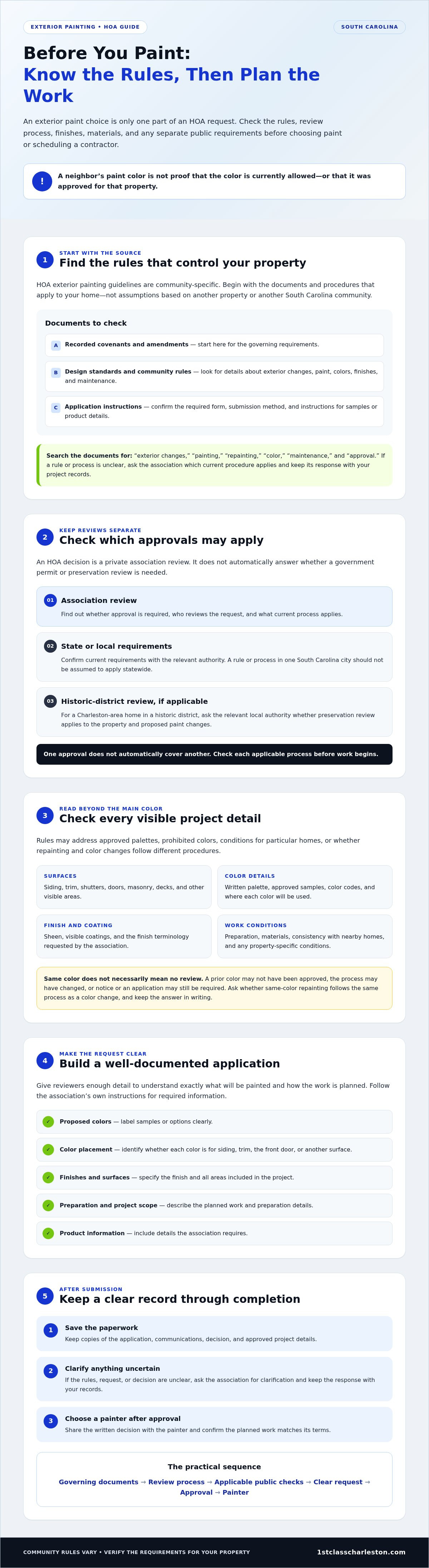
South Carolina HOA Painting Checklist: Approval, Follow-Up, and Disagreements
A clear sequence can keep an exterior painting project on track. Use this checklist to manage the HOA process, document each step, and avoid treating an unanswered application as permission to begin. HOA exterior painting guidelines South Carolina homeowners encounter are community-specific, so follow the procedure that applies to your property.
- Review the governing documents. Find the current covenants, amendments, architectural standards, and application instructions. Note who reviews requests and whether the rules describe a review period or appeal process.
- Ask questions before applying. Confirm unclear requirements, including how to submit samples, what details to include, and how decisions are communicated.
- Submit a complete request. Use the required form and include the colors, finishes, surfaces, preparation scope, photos, and other requested information.
- Wait for the written decision. Save the notice and check that it clearly identifies the approved project details. Don’t assume silence means approval.
- Confirm other requirements, then schedule. If local or historic-district review may apply, verify it with the relevant authority. Schedule once required approvals and project logistics are clear.
Keep one project file with the application, labeled samples, photos, HOA communications, written decision, and final approved details. A complete record makes it easier to confirm what was submitted and authorized if questions arise.
What if the HOA rejects or delays a paint request?
Ask the association to identify the decision and the specific governing-document provision it relied on, in writing. If the request is delayed, ask when or how to expect a response. Find out whether revisions, additional samples, or a formal appeal are available, and follow the process in the community’s documents. Don’t start work based on an assumption that no response means consent.
For a legal question you can’t resolve by reviewing the documents or asking the association, consult a South Carolina attorney. The association makes its own review decisions. A painting contractor can help clarify project scope and paint-work details, but shouldn’t be treated as a source of legal advice.
When should homeowners check city or historic-district review?
If your home is in a designated historic area or has special review conditions, contact the relevant municipality or local preservation authority before choosing dates or starting work. Requirements can depend on the property and proposed changes, so verify them directly instead of relying on a neighbor’s experience. Keep any public approvals with your HOA authorization in the project file.
Once approvals are settled, a professional exterior painter can help align the work plan with the written authorization. Learn more about exterior painting services as you prepare to move from approval to scheduling.
Choosing an Exterior Painter After HOA Approval
Once you have written approval, contractor selection is the next step. Hiring a painter doesn’t replace HOA review, and approval doesn’t automatically confirm every detail of the work plan. Share the decision and any approved samples with prospective painters so they know which colors, finishes, and surfaces are authorized.
Use the written approval to compare proposals on the same scope. Ask each painter to describe the preparation, surfaces to be painted, proposed finish, schedule, cleanup, and communication plan. If a proposal omits an approved surface or includes work beyond what the association authorized, ask questions before choosing a contractor.
How can a painter help keep the approved scope clear?
Request a written description of the work, including which areas will be painted and how they’ll be prepared. Compare it with the HOA’s decision. Does it name the same colors and locations, such as siding, trim, or shutters? If the contractor recommends a change, clarify whether it affects the approved scope. Check with the association about any change that may need review before proceeding.
A clear scope also helps you compare contractors fairly. Look for specific descriptions rather than broad phrases like “paint the exterior.” Discuss surface coverage, preparation methods, finishes, cleanup, and how updates will be shared if plans or site conditions change.
What should Charleston-area homeowners ask before work begins?
Exterior work depends on surface conditions and weather. Ask how the proposed schedule accounts for both, and how the painter will communicate if conditions affect timing. Confirm how landscaping, adjacent surfaces, and the home’s surroundings will be protected, and discuss equipment placement and cleanup.
- Does the written work plan match the colors, finishes, and areas in the HOA approval?
- What preparation and surface coverage are included?
- How will the team protect landscaping and nearby surfaces?
- How will schedule changes or proposed scope adjustments be discussed?
These questions help turn the HOA exterior painting guidelines South Carolina homeowners have reviewed into a clear project plan. 1st Class Painting & Restoration is locally owned and operated in the Charleston area and provides exterior painting. After confirming your association’s requirements, you can discuss your exterior painting project and its scope.
Move Forward With a Clear Painting Plan
A smoother exterior painting project starts with knowing which HOA documents and review steps apply to your home. Confirm the colors, finishes, and surfaces allowed, then submit a complete request and wait for the written decision before scheduling. HOA exterior painting guidelines South Carolina communities follow can vary, so keep your approval and project details together as you plan.
Once approval requirements are clear, share them with your painter and make sure the proposed work matches the approved scope. Clear communication about preparation, schedule, and property protection can help everyone start on the same page.
For help planning the painting work, 1st Class Painting & Restoration is a locally owned painting and restoration company serving the Charleston area, with residential and commercial exterior painting among its services. Discuss your exterior painting project with 1st Class Painting & Restoration after confirming your HOA requirements. With preparation and the required approvals in place, you can move toward a fresh exterior with greater confidence.
Frequently Asked Questions
Do I need HOA approval to repaint my house the same color in South Carolina?
Possibly, so check your community’s documents before starting, even if you plan to use the existing color. HOA exterior painting guidelines South Carolina communities adopt may require an application for repainting, while others may distinguish routine maintenance from a color change. An existing color doesn’t prove it was approved or that the current process is unchanged. Ask the association whether same-color repainting requires approval or notice, and keep its written response with your project records.
Can an HOA in South Carolina dictate the exterior paint colors I use?
An HOA may set color requirements when its governing documents give it authority to review exterior changes. Those rules can include an approved palette, restrictions, or property-specific conditions, but the controlling details depend on the documents that apply to your community. Review the covenants, amendments, and architectural standards before selecting paint. If a rule seems unclear or conflicts with another document, ask the association to explain its interpretation. Consult a South Carolina attorney for unresolved legal questions.
What should I submit for HOA exterior paint approval?
Follow the association’s required form and instructions first. A complete request may identify each proposed color and finish, the surfaces to be painted, preparation details, and relevant paint or coating information if requested. Include current photos and labeled samples when the review process permits them. For example, specify which color is for the siding and which is for the trim. Confirm acceptable sample formats and keep a copy of every item you submit.
What happens if I paint my home before getting HOA approval?
The association may treat unapproved work as a violation if its governing documents require advance approval. Possible next steps depend on those documents and the circumstances, so don’t assume a particular penalty or that repainting will automatically be required. Contact the HOA promptly, ask which rule applies, and request its directions in writing. Keep project records and communications. If the association’s response raises legal concerns, consider speaking with a South Carolina attorney.
Can an HOA require me to repaint my house in South Carolina?
An HOA may seek action over exterior paint if the association’s governing documents support that requirement and its procedures apply. Whether it can require repainting in a particular situation depends on the relevant documents and facts, so a neighbor’s experience may not settle your case. Ask the association to identify the specific provision and explain the next step in writing. For a dispute over your legal rights or obligations, consult a South Carolina attorney.
Do Charleston historic-district rules affect HOA exterior painting approval?
They may. If your Charleston-area home is in a designated historic area or has special review conditions, check with the relevant local preservation authority to see whether separate review applies to your proposed paint work. HOA approval and public review are separate processes, and one may not replace the other. Verify current requirements for your address before setting a start date, then keep any local decision alongside the association’s written authorization.
How long does HOA approval for exterior painting take?
There’s no single timeline that applies to every South Carolina HOA. Review timing can depend on your association’s submission deadlines, meeting schedule, review process, and whether it needs more information. Check the governing documents and application instructions for any stated timeframe, then ask the association how it communicates decisions and how to follow up. Don’t treat an estimate, missed deadline, or lack of response as approval unless the applicable written rules clearly say so.
Should I hire a painter before my HOA approves the exterior colors?
You can discuss project scope or seek information before approval, but it’s wise to wait for the required written decision before committing to a work date or final color selection. Once approved, share the decision with your painter and confirm the written plan matches the authorized colors, finishes, and surfaces. A professional painter can help clarify preparation and project scope, but can’t make the HOA’s decision or guarantee approval. Check any separate local review requirements, too.


