
How to Protect Exterior Paint from Coastal Humidity: A Lowcountry Guide
Learn how to protect exterior paint from coastal humidity in the Lowcountry. Our guide covers pro tips on paint choice, prep, and salt removal for a lasting ...

In Charleston, the air doesn't just hold moisture; it tries to reclaim your home. You've likely seen the green haze of mildew creeping up your siding or felt the heartbreak of watching historic wood trim flake away far too soon. It's a common struggle for Lowcountry homeowners who find themselves trapped in a cycle of frequent, expensive repainting. If you're wondering how to protect exterior paint from coastal humidity, you aren't alone. The salt air and humidity levels that regularly climb toward 90% are relentless, but they don't have to win. We believe your home should be a source of pride, not a constant maintenance headache.
We've spent 23 years mastering the unique demands of our local climate. In this guide, you'll discover the professional secrets to shielding your Charleston home from moisture and salt. We'll show you how a restoration first mindset leads to a paint job that lasts 10 years or more. From choosing breathable high-performance coatings to the meticulous prep work that defines a true craftsman's touch, we're covering everything you need to enhance your curb appeal for the long haul. Let's look at how to stop the peeling and start protecting your investment with confidence.
Key Takeaways
- Learn why Charleston’s 90% humidity creates unique hydrostatic pressure that can push paint right off your siding if not properly managed.
- Discover how to protect exterior paint from coastal humidity by selecting 100% acrylic latex systems and advanced mildewcide additives.
- Understand the "Dry-Out Rule" and why professional moisture meters are essential before the first drop of paint ever touches your home.
- See why neutralizing salt deposits is more critical than a standard pressure wash for homes near the Atlantic.
- Identify the high-risk "flash points" on your home’s exterior to prevent small moisture issues from becoming expensive repairs.
The Science of Lowcountry Humidity: Why Paint Fails in Charleston
Humidity is a ghost. In Charleston, we don't just deal with rain; we live in an atmosphere that is often 60% to 90% water vapor. While rain usually rolls off a well-maintained surface, humidity drifts into the very pores of your home's siding. This constant moisture saturation is the primary reason why standard paint jobs fail so quickly here. When you are looking for how to protect exterior paint from coastal humidity, you have to look beyond the surface. It's not just about what is hitting the paint from the outside; it's about the moisture trapped underneath it.
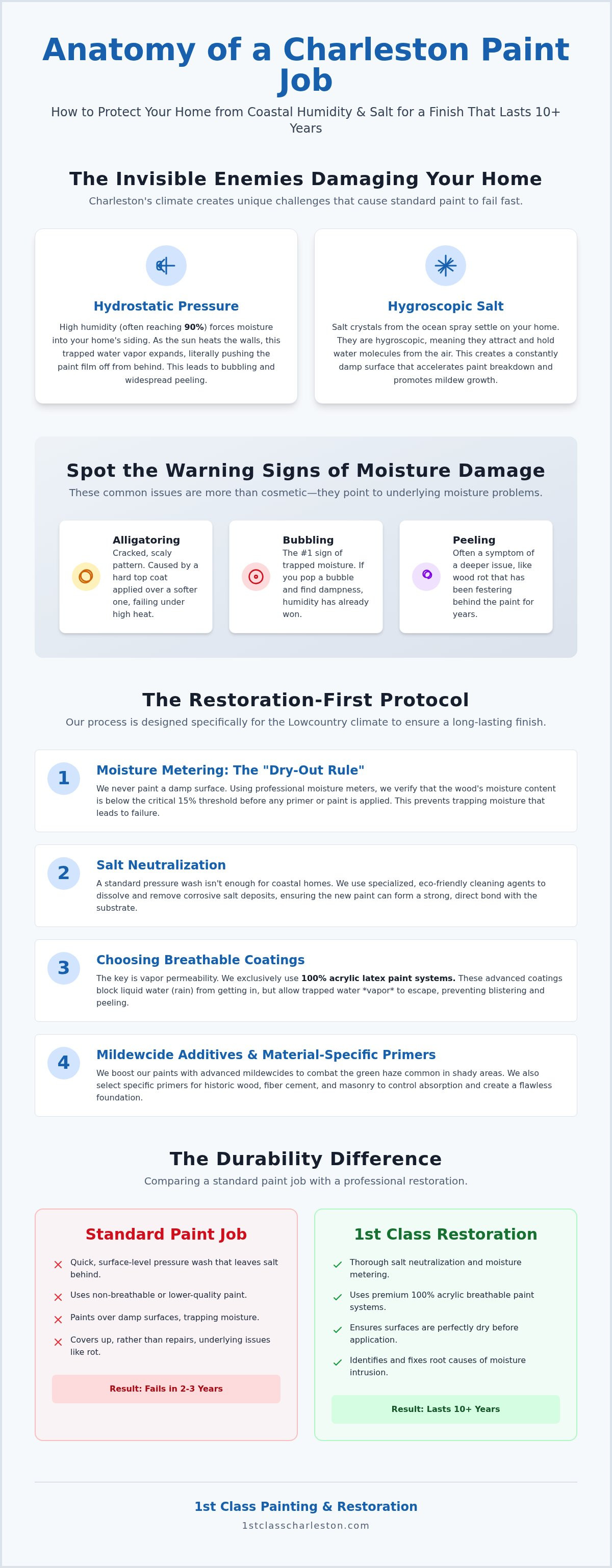
Hydrostatic pressure is the invisible force that ruins many Lowcountry exteriors. When humidity is high, moisture penetrates the wood or masonry from the inside of the house or through small gaps in the trim. As the sun heats the walls, that trapped water tries to evaporate and expand. If the paint is too thick or brittle, this pressure literally pushes the paint film away from the house. This leads to many common reasons for paint failure, including unsightly blisters and large, hanging sheets of peeling color. Vapor permeability is the most critical factor for coastal paint because it allows the substrate to "breathe" by letting moisture vapor escape without breaking the paint's bond.
Salt air acts as a relentless catalyst in this process. Salt crystals are hygroscopic, which means they naturally attract and hold onto water molecules from the air. When salt spray settles on your siding, it creates a damp film that stays wet long after the morning dew has evaporated. This localized dampness accelerates the breakdown of the paint's chemical bonds and provides a perfect breeding ground for mildew.
The Charleston Micro-Climate Effect
Location is everything in the Lowcountry. If you own a home on the Battery, your exterior faces a direct assault from wind-driven salt spray and intense sun reflection off the water. These homes often require more frequent salt neutralization than a property in Summerville or Goose Creek. Inland neighborhoods face different threats, such as heavy foliage and ancient oak canopies. These beautiful trees create deep shade that prevents siding from drying out, leading to aggressive mildew growth on the north-facing sides of historic homes. Homes within five miles of the coast are in the "high-salt zone," where salt deposits can accumulate daily.
Signs of Humidity-Related Paint Failure
You can tell a lot about your home's health by looking closely at the texture of the failing paint. Alligatoring looks like the cracked, scaly skin of a reptile and usually happens when a hard coating is applied over a softer one in high-heat conditions. Bubbling, however, is almost always a sign of a substrate moisture problem. If you pop a bubble and find damp wood underneath, the humidity has already won that round. We often find that "simple" peeling is actually a symptom of deep-seated wood rot that has been festering behind the paint layer for years. Finding these signs early is the first step toward a true restoration rather than a temporary cover-up.
Substrate Matters: How Charleston Building Materials React to Moisture
Texture matters. Every surface in the Lowcountry has a unique "thirst," and understanding the specific material of your home is the first step in learning how to protect exterior paint from coastal humidity. Charleston is a beautiful tapestry of historic wood, modern siding, and centuries-old masonry. However, what works for a new build in Mount Pleasant could be a disaster for a single house on Church Street. Humidity doesn't just sit on the surface; it interacts with the very cellular structure of your home's walls.
- Historic Wood: Old-growth cypress and heart pine are remarkably resilient but highly porous, requiring specialized primers to handle moisture.
- Fiber Cement: Modern siding like Hardie Plank resists rot but can suffer from "edge-wicking" in 90% humidity if the factory seals are broken.
- Masonry: Charleston stucco and brick are essentially sponges; trapping moisture inside these materials leads to structural decay.
Brick and masonry require particular care. Many homeowners think "sealing" brick is the best defense against the salt air. In reality, this is often a mistake. Sealing traps water vapor inside the brick, and when the Charleston sun hits those walls, the pressure can cause the face of the brick to pop off. We see this frequently in older neighborhoods where the wrong coatings have been used. Our team specializes in historic exterior restoration to ensure your home's specific materials are treated with the care they deserve.
Protecting Historic Lowcountry Woodwork
Old-growth cypress is a Lowcountry treasure. These woods are dense and naturally rot-resistant, yet they expand and contract significantly as our local dew points shift. Research from the USDA Forest Service explains exactly how moisture causes paint to fail when wood fibers saturate and swell, pushing the paint film away from the surface. To truly protect these surfaces, we often recommend stripping back decades of failing, brittle layers to reach the bare wood. This "reset" allows modern, breathable primers to bond directly to the grain, creating a flexible foundation that moves with the wood instead of cracking under the SC heat.
Stucco and Masonry Breathability
Stucco is a classic Charleston look, but it's famously porous. Many homeowners reach for elastomeric coatings because they bridge small cracks and feel like a "rubber shield." However, these can be a double-edged sword. If moisture gets behind an elastomeric barrier, it can't escape, leading to "spalling" where the stucco face actually breaks away from the lath. We prefer high-quality, 100% acrylics or mineral-based paints for historic masonry. These products allow salt and vapor to pass through the coating without causing the white, powdery stains known as efflorescence. By choosing a breathable system, you ensure that humidity doesn't become a permanent resident inside your walls.
Choosing the Right Defense: Best Paint Types for Coastal Humidity
Defense begins with chemistry. In the Lowcountry, the debate between oil and acrylic is settled by the sun and the swamp. While oil-based paints were once the standard for durability, they become brittle over time. In our intense UV environment, that brittleness leads to micro-cracking; once the surface cracks, humidity rushes in. 100% acrylic latex is the undisputed king for coastal homes because it remains flexible. It expands and contracts with your siding, acting like a protective skin rather than a rigid shell. This flexibility is a cornerstone of how to protect exterior paint from coastal humidity.
Your paint also needs an active defense. We always prioritize coatings with high concentrations of mildewcides. These additives inhibit fungal growth before it can take root in the humid air. Along with chemistry, consider the physics of sheen. Flat paints have a porous, "toothy" texture that holds onto salt and moisture. Satin and semi-gloss finishes provide a smoother surface that allows water to bead and shed effectively. This prevents the "damp blanket" effect that often leads to premature peeling on flat-painted surfaces.
The Technology of Self-Cleaning Paints
Modern innovation has changed the game for Charleston homeowners. High-performance coatings like Benjamin Moore Aura or Sherwin-Williams Duration utilize "high-build" formulas. These create a thicker, more resilient barrier in fewer coats. Some of these advanced systems are even hydrophilic. They are designed to wash away salt deposits and dirt every time a summer afternoon thunderstorm rolls through. By keeping the surface clean, these paints remove the food sources that mold and mildew need to thrive. It's a proactive way to maintain curb appeal without constant scrubbing!
Breathable Coatings: The Vapor Permeability Factor
Don't let the word "waterproof" fool you. In a restoration context, a completely waterproof coating can be a liability. We focus on "Perm Ratings," which measure how much water vapor can pass through the paint film. A high perm rating is essential for Charleston’s historic homes. It allows the house to "exhale" the moisture that naturally accumulates inside. If you seal a home with a non-breathable coating, you’re essentially wrapping it in plastic wrap. The moisture will eventually force its way out, taking your expensive paint job with it. True protection means blocking liquid water from the outside while letting vapor escape from the inside.
The 1st Class Prep Protocol: Ensuring a Long-Lasting Bond
Preparation is where the battle against the coast is won or lost. In our local market, a staggering 60% to 70% of professional labor hours are dedicated to preparation work rather than the actual application of paint. This isn't just about making the house look tidy. It's about creating a foundation that can withstand the relentless pressure of a South Carolina summer. To truly understand how to protect exterior paint from coastal humidity, you have to start with the "Dry-Out" Rule. We don't guess when a surface is ready; we use professional moisture meters to ensure the substrate is bone-dry before the first brush stroke ever happens.
Scraping and sanding are equally vital components of our restoration process. We focus on creating a "mechanical bond," which means roughening the surface just enough so the new coating has something to grab onto. Without this step, the high humidity acts as a lubricant, causing new paint to slide right off the old layers. We take the time to fix the wood before we ever think about the color.
Professional Washing and Salt Removal
A standard pressure wash isn't enough for a Lowcountry home. In fact, high-pressure washing can often force water deep into the wood grain or behind the siding, leading to trapped moisture. We utilize a "soft wash" approach combined with specific salt neutralizers. These specialized solutions strip away microscopic salt crystals that a normal rinse simply leaves behind. If these crystals stay on the surface, they will continue to attract moisture through the new paint.
Timing is everything. In Charleston’s typical 80% humidity, waiting for a house to dry is an exercise in patience. We often require a full 48 to 72 hours of dry weather after washing before we proceed. If you paint over a damp surface, you are essentially sealing in the very moisture that will eventually cause the paint to bubble and peel. We believe in doing it right the first time, even if it means waiting for the perfect weather window.
Priming for Success
Priming is the bridge between your home and its new defense. For troubled surfaces where previous layers have failed, we often use high-performance "peel-bonding" primers. These formulas are designed to glue down the edges of old paint and provide a thick, flexible base for the topcoat. The secret to a 10-year finish is often found in meticulous spot-priming. We treat every exposed nail head and every sanded patch of wood as a high-risk area. If you want a team that treats your home with this level of detail, schedule an exterior painting consultation with our local experts today. We take personal honor in getting these invisible steps right!
Long-Term Maintenance: Keeping the Humidity at Bay
A great paint job is an investment. In Charleston, that investment needs a little neighborly care to stay beautiful. Once you've implemented the right systems for how to protect exterior paint from coastal humidity, the goal shifts to preservation. Maintenance isn't about scrubbing your house every weekend. It's about strategic, annual actions that prevent salt and mold from gaining a foothold. Think of it as a wellness check for your home's exterior.
Your first line of defense is the annual wash. This isn't the deep chemical neutralization we perform during prep; it’s a gentle rinse to remove surface salt and pollen. If left alone, these particles trap moisture against the paint film, creating a damp environment where mildew thrives. We also recommend keeping a close eye on "flash points." These are the horizontal surfaces like window sills and door frames where water tends to sit. If you see small cracks or thinning paint in these areas, a quick touch-up can prevent water from reaching the wood underneath.
Vegetation management is another vital piece of the puzzle. We love our lush Lowcountry gardens, but keeping bushes and vines at least 12 inches away from your siding is essential. When plants touch your house, they create "micro-humidity zones" that never dry out. This constant dampness will eat through even the best paint in just a few seasons. Give your siding room to breathe, and it will reward you with years of vibrant color.
A Seasonal Maintenance Checklist
- Spring: Check for pollen buildup and moisture damage from winter rains. This is the best time for a gentle wash to refresh the surface.
- Fall: Inspect your home after hurricane season. Wind-driven debris can create small chips in the paint that allow humidity to infiltrate the substrate.
When doing touch-ups, remember that exterior paint weathers over time. If you use a leftover can from three years ago, the color might not match perfectly. We recommend feathering the edges of your touch-up to help it blend with the naturally aged finish of the surrounding wall. This small effort keeps the curb appeal high without needing a full repaint.
Why Restoration Beats a Quick Coat
Sometimes, a simple repaint isn't enough. If you're seeing consistent bubbling or soft spots in your trim, you're dealing with a substrate issue. This is where our "Restoration" focus shines. We don't just hide damage; we fix the underlying wood rot before any paint is applied. This meticulous approach adds significant value to Charleston real estate by ensuring the structural integrity of the home is preserved. A quick coat might look good for a summer, but a professional restoration lasts a decade. Ready to see the difference for yourself? Schedule your professional exterior assessment with 1st Class Painting & Restoration and let’s make your home the pride of the neighborhood!
Revitalize Your Charleston Home for the Long Haul
Your home is more than just a property. It's a sanctuary. Protecting it from our relentless atmosphere requires more than a fresh coat of color. You now know that mastering how to protect exterior paint from coastal humidity starts with a restoration mindset. Focus on vapor permeability. Use moisture meters. Neutralize salt. By following these professional steps, you can break the cycle of frequent repainting. This approach ensures a finish that lasts a decade while beautifully enhancing your curb appeal.
We take immense pride in our craft. We're a locally owned and operated team with 23 years of Charleston-specific experience. Our specialized coastal prep protocol is designed for the unique challenges of the Battery, Summerville, and everywhere in between. You don't have to settle for peeling trim or recurring mildew! We're ready to help you transform your exterior into a durable masterpiece that stands up to the salt and sun.
Get a Free Exterior Restoration Estimate from Charleston’s Coastal Experts
Frequently Asked Questions
How often should I repaint my house in a coastal area like Charleston?
Most homes in the Charleston area require a fresh coat of paint every 5 to 7 years to stay protected. However, if you follow a professional strategy for how to protect exterior paint from coastal humidity, you can often extend that life to 10 years or more. Factors like direct salt spray on the Battery or intense sun exposure on south-facing walls will naturally shorten this window without consistent maintenance.
Is there a specific paint that prevents mold and mildew in high humidity?
You should look for 100% acrylic latex paints that include high concentrations of built-in mildewcides. These specialized additives are designed to inhibit fungal growth on the surface before it can take root in our humid air. We often recommend high-build formulas because they create a thicker, more resilient barrier. These advanced coatings remain flexible and breathable, which is essential for resisting the organic growth that typically plagues older, oil-based finishes.
Can I paint my house if the humidity is over 80%?
We generally advise against applying paint when the relative humidity exceeds 85% because the coating won't cure correctly. At these high levels, the water in the paint cannot evaporate at the right speed, which prevents the film from forming a durable bond. If you paint in 90% humidity, you risk a gummy finish that attracts dirt and fails prematurely. It is always best to wait for a clear, dry weather window.
Why is my paint peeling even though I used an expensive brand?
Even the most expensive paint will fail if the underlying preparation was rushed or skipped. Peeling is usually a sign of a bond failure caused by trapped moisture, microscopic salt deposits, or a chalky old surface that wasn't properly sanded. If the wood was damp during application, the resulting hydrostatic pressure will eventually push any brand of paint right off the siding. True protection requires fixing the substrate before you ever apply the color.
Does salt air affect paint even if I don’t live directly on the ocean?
Yes, salt air can travel several miles inland and affect homes in Summerville or West Ashley just as it does on the coast. These microscopic salt crystals are hygroscopic, which means they pull moisture from the air and hold it against your siding. This creates a constant dampness that breaks down the paint's chemical binders. Regular soft washing is essential for every Lowcountry homeowner to remove these corrosive deposits before they cause damage.
What is the best time of year to paint the exterior of a Charleston home?
The ideal windows for exterior painting in the Lowcountry are typically late spring and early fall. During these months, the humidity is usually lower and temperatures stay in the moderate range between 50 and 85 degrees. Avoid the peak of summer when daily afternoon thunderstorms and oppressive humidity are common. Painting during the right season ensures the coating cures properly, which is a vital part of how to protect exterior paint from coastal humidity.
How do I know if my siding has moisture damage or just needs new paint?
Look for soft spots in the wood or dark, tea-colored stains bleeding through the existing paint. If you see paint bubbling or scaly textures, it often indicates that moisture has already infiltrated the wood grain. You can test this by gently pressing a screwdriver into the trim; if the wood feels spongy, you have rot that requires restoration. Simply painting over these areas will only hide the problem while the decay continues to spread.
Should I use a sealer on my exterior paint to protect it from humidity?
We strongly advise against using clear sealers over your exterior paint. While it might sound like a good way to add protection, most sealers create a non-breathable barrier that traps water vapor inside your walls. Your home needs to exhale moisture to stay healthy and dry. If that vapor can't escape through the paint, it will build up pressure and cause the finish to blister and peel away from the surface.


