
Is It Time to Repaint? 7 Critical Signs Your Home Exterior Needs Help
See 7 signs your home needs repainting. Find the best exterior paint for Charleston SC climate to protect against humidity, salt air, and costly wood rot.

In the Lowcountry, a single peeling flake of paint is rarely just a cosmetic flaw. It is an open invitation for our relentless Atlantic humidity to begin a slow, expensive assault on your home's wooden skeleton. Protection. Resilience. Integrity. These are the silent jobs your home's exterior must perform every single day. Finding the best exterior paint for Charleston SC climate is about more than aesthetics; it is about creating a durable shield against salt air and punishing UV rays.
We understand the anxiety that comes with spotting a new crack or a patch of chalky residue. You want to preserve your property's beauty without being blindsided by the high cost of hidden wood rot. It's a common concern for any Charleston homeowner who values both history and craftsmanship. This article provides the clarity you need to evaluate your home's health with confidence. We'll walk through the seven critical red flags that indicate your protective barrier is failing. You'll also explore the specific risks of the coastal South Carolina climate and why a restoration-minded approach is the only way to truly save your home's structure. Let's ensure your property remains a sanctuary rather than a source of stress.
Key Takeaways
- Spot the visual "red flags" like peeling and cracking that prove your home's protective barrier is no longer functioning.
- Learn why selecting the best exterior paint for Charleston SC climate is essential for resisting salt air corrosion and high coastal humidity.
- Discover how to identify hidden wood rot and failing caulk before moisture causes permanent structural damage to your siding.
- Understand how your specific siding material and sun exposure levels determine the ideal timeline for your next refresh.
- See why a restoration-first strategy protects your investment by repairing the underlying structure before applying any new paint.
The Visual Red Flags: Obvious Signs Your Paint Is Failing
Wait. Step back and look at your siding. Is it actually protecting your home, or is it just barely hanging on? In our humid Lowcountry environment, paint isn't just a color choice; it's a vital structural seal. When that seal breaks, the clock starts ticking on wood rot and moisture damage. Identifying these red flags early can save you thousands in future restoration costs.
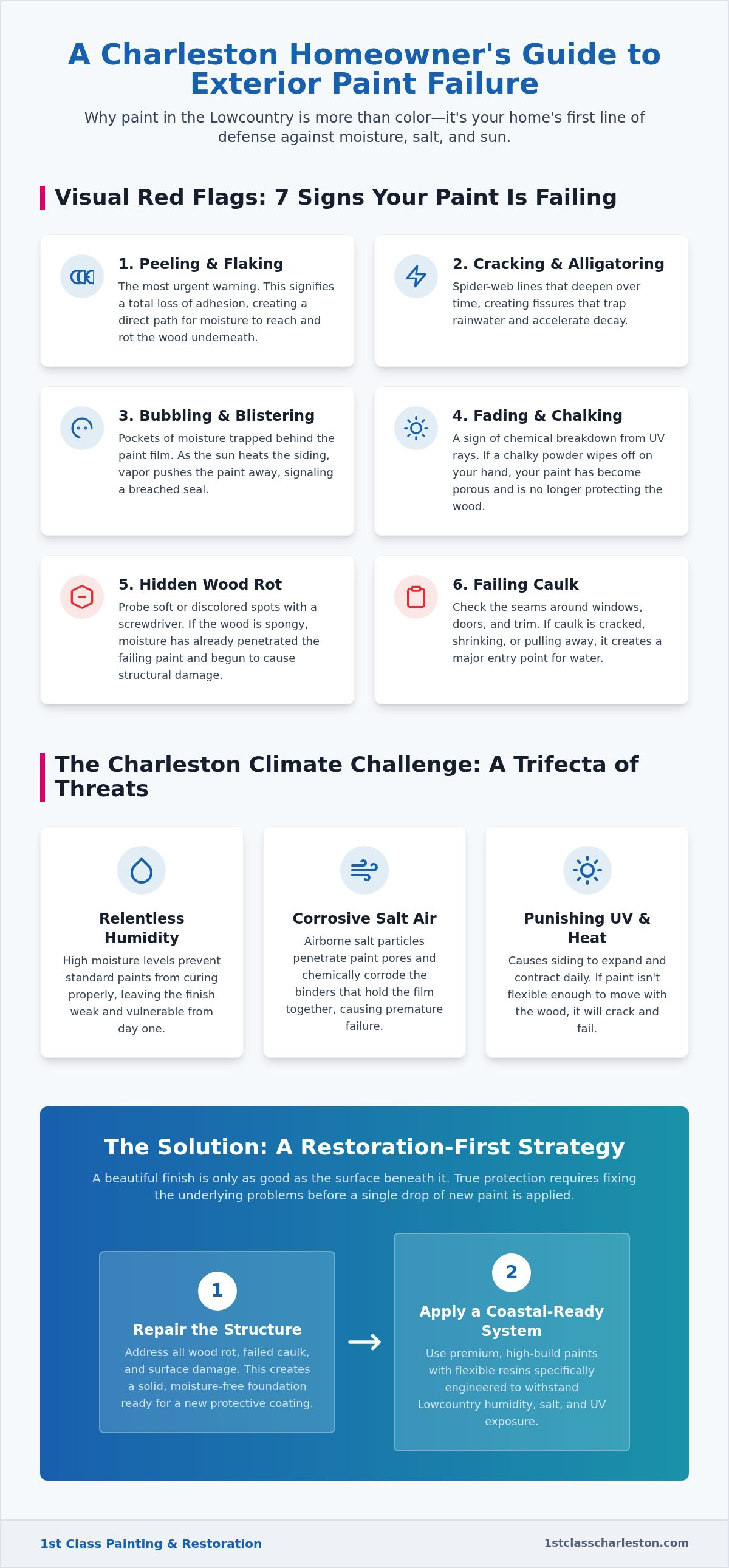
Peeling and flaking are perhaps the most urgent warnings you'll encounter. They signify a total loss of adhesion between the paint film and your siding. Once the paint lifts, moisture finds a direct path to the wood. Similarly, cracking and "alligatoring" create deep fissures in the finish. These tiny spider-web lines eventually turn into deep canyons that swallow rainwater. Bubbling and blistering are equally deceptive. These pockets form when moisture is trapped behind the paint film, often due to common causes of paint failure like poor surface preparation or choosing a product that isn't the best exterior paint for Charleston SC climate. As the sun heats the siding, that moisture turns to vapor and pushes the paint away from the surface. It's a clear signal that your home's first line of defense has been breached.
The Difference Between Chipping and Peeling
It's easy to confuse these two issues, but their implications for your home's health are very different. Chipping usually happens from a localized impact. Think of a ladder bump, a stray lawnmower pebble, or kids playing ball against the house. It's an isolated wound that can often be touched up. Peeling, however, is a systemic cry for help. It means the primer or the paint itself has detached from the substrate across a wide area. You can't just "patch" peeling paint. It requires a meticulous strip-down and a fresh start to ensure the new layer actually sticks to the wood. At 1st Class Painting & Restoration, we prioritize this level of preparation because we know a beautiful finish is only as good as the surface beneath it.
Fading: More Than Just a Cosmetic Issue
Don't ignore a dull or washed-out finish. While many homeowners see fading as a style problem, it's actually a sign of chemical breakdown. Intense UV rays in the South destroy the binders that hold paint together. You can test this yourself with the "Chalking Test." Run your hand across a faded board; if a white, powdery residue comes off on your fingers, your paint has officially turned to dust. Faded, chalky paint is porous. It absorbs more heat and moisture than a healthy coat, which accelerates the decay of the wood underneath. Selecting the best exterior paint for Charleston SC climate is the only way to ensure your home stays vibrant and protected against our unique coastal challenges. A fresh, high-quality coat reflects heat and sheds water, keeping your home's structure safe and sound.
The Charleston Factor: Choosing the Best Exterior Paint for Our Climate
Charleston is beautiful, but it's a brutal environment for a home. While homeowners in other regions worry about snow or dry heat, we face a relentless trifecta of salt, sun, and steam. Humidity here isn't just a comfort issue. It is a chemical barrier. When moisture levels stay high, standard paint films struggle to cure properly, leaving them vulnerable from day one. You need a coating that understands the Lowcountry.
Salt air is the hidden saboteur. It doesn't just sit on the surface; it penetrates pores and accelerates the breakdown of traditional binders. This leads to early failure that looks like the peeling we discussed earlier but is driven by chemical corrosion. Add in our intense thermal expansion, where siding swells in the afternoon heat and shrinks in the cool evening breeze, and you have a recipe for disaster. If your paint isn't flexible enough to move with the wood, it will snap. This is why we prioritize high-quality resins that can stretch without breaking under the Southern sun.
What Makes the Best Exterior Paint for Lowcountry Humidity?
Success in the South requires more than just a thick coat of color. The best exterior paint for Charleston SC climate must feature high-build technology that creates a breathable yet impermeable barrier. We often look toward climate-appropriate paint technologies to understand how modern coatings can regulate temperature and resist moisture ingress. Standard big-box paints often lack the high resin content needed to withstand our 90% humidity days. At 1st Class Painting & Restoration, we select premium products specifically engineered for coastal durability, ensuring your home doesn't just look good for a season, but stays protected for years.
Mildew and Algae: The Silent Warning
Have you noticed a persistent green or black tint on your North-facing walls? That isn't just dirt. Mold, mildew, and algae thrive in our damp air, literally feeding on the organic binders found in lower-quality paints. While a quick power wash might clear the surface temporarily, it doesn't solve the underlying problem. If the paint film is compromised, these organisms can take root in the wood fibers themselves. This biological growth is a precursor to wood rot, which is why our team always performs a structural audit before we ever pick up a brush. If you're tired of fighting the "Green Tint," it might be time for a professional exterior evaluation to see if your current coating is actually inviting damage. Finding the best exterior paint for Charleston SC climate means choosing a product with advanced antimicrobial properties to keep your home healthy.
Beyond the Surface: Identifying Structural Damage and Wood Rot
Paint failure is often more than skin deep. While fading or peeling looks bad, what happens underneath is what truly threatens your home's integrity. In the Lowcountry, we don't just paint; we restore. If you ignore the structural signs, even the best exterior paint for Charleston SC climate won't stay bonded for long. You must look for the clues that moisture has already moved past the surface.
Walk around your home with a flathead screwdriver. Gently press the tip into window sills, door frames, and the bottom edges of your siding. Does the wood feel firm, or does it give way like a sponge? If the tool sinks in, you've found a soft spot where moisture has won the battle. You might also notice rusty nail heads. These orange or brown streaks are a smoking gun. They tell us that moisture has bypassed the paint layer entirely, reaching the metal fasteners and the wood behind them. If you've noticed new drafts or unexplained interior moisture, your exterior paint failure may already be affecting your indoor air quality.
Defining Wood Rot in the Coastal South
Wood rot is fungal decay caused by moisture exceeding 20% in wood fibers. This biological process is relentless once it takes hold. In Charleston homes, we most frequently see wet rot, which requires a consistent water source to survive. Dry rot is less common but can be more destructive because it spreads through non-wood materials to find fresh timber. Painting over rot is the most expensive mistake a homeowner can make. It creates a seal that traps fungal spores and moisture inside, allowing the decay to hollow out your home's structure while looking perfectly fine from the street.
The Importance of Caulking and Sealing
Caulk acts as the first responder in your home's moisture defense system. It is the flexible bridge that keeps driving rain out of the vulnerable gaps around windows, doors, and corner boards. If you see caulk that is brittle, pulling away from the wood, or missing entirely, it is a sign that your home is unprotected. Over time, our intense UV rays cause seals to lose their elasticity. At 1st Class Painting & Restoration, we integrate professional-grade sealing into every exterior project. We ensure your home is watertight from the foundation to the eaves before we apply the best exterior paint for Charleston SC climate.
The Repainting Timeline: How Often Does Your Home Need a Refresh?
Timing is everything. In our unique coastal environment, waiting just one year too long can be the difference between a simple repaint and a full-scale structural restoration. The lifespan of your home's finish isn't just about the date on the calendar. It's about the material of your siding, the direction your home faces, and the quality of the prep work performed during the last project. If you want to protect your investment, you must understand the specific rhythm of the Lowcountry.
South-facing walls are the canary in the coal mine. These surfaces absorb the full, punishing force of the midday sun, causing paint to bake and brittle much faster than the shaded north side. If your previous contractor cut corners on preparation, even the best exterior paint for Charleston SC climate will fail prematurely. Poor sanding or cheap primers can cut a paint's lifespan in half, leading to the peeling and cracking we identified earlier. We often tell homeowners about the "Maintenance Window." Painting at year six is almost always cheaper than waiting until year ten. By year ten, moisture has usually found its way into the wood, requiring expensive restoration work before the first drop of new paint can be applied.
Repainting Schedule by Siding Type
Wood siding is the most demanding material in our region. Because wood is organic and porous, it typically needs professional care every 3 to 7 years. This range depends heavily on your home's shade and sun exposure. Stucco and brick are more resilient but still require attention every 5 to 10 years. For these surfaces, we focus on elastomeric coatings that bridge small cracks and seal out moisture. Fiber cement siding, like HardiePlank, is incredibly durable and can often go 10 to 15 years between repaints. However, you must watch your wooden trim carefully; the trim often fails long before the siding does.
Factors That Shorten Your Paint Lifespan
Proximity to the ocean is the biggest variable. If your home sits within reach of direct salt spray, the corrosive air will degrade paint binders rapidly. Maintenance habits also play a major role. Clogged gutters lead to water splash-back on lower siding boards, creating a permanent damp zone that invites rot. Finally, using low-sheen finishes in high-moisture areas can be a mistake. Satin and semi-gloss finishes shed water more effectively than flat paints. If you aren't sure where your home stands in its lifecycle, it's time to schedule a professional exterior assessment. Choosing the best exterior paint for Charleston SC climate is only half the battle; knowing when to apply it is what truly saves your home.
Protecting Your Investment with 1st Class Painting & Restoration
Expertise matters. In a city where history meets the sea, you cannot afford a "one size fits all" approach to your home's exterior. At 1st Class Painting & Restoration, we've spent 23 years perfecting the art of Lowcountry property care. We don't just see a house; we see a legacy that needs protection. Our process begins with a comprehensive structural audit because applying the best exterior paint for Charleston SC climate is useless if the wood beneath it is compromised.
We are craftsmen first. While large franchises might focus on speed and volume, our team prioritizes the long-term health of your property. This means we identify and fix wood rot, failing caulk, and structural soft spots before the first drop of paint ever touches your siding. This restoration-first philosophy ensures that your new finish doesn't just look beautiful on day one but continues to shield your home for years to come. It's about pride, honor, and a job well done.
Why a Restoration Mindset Matters
Charleston's historic districts require a level of specialized, period-correct care that only a local expert can provide. As a locally owned team that lives in the climate we serve, we understand exactly how salt air and humidity attempt to dismantle your home's defenses. Our specific process involves meticulous surface preparation and the selection of premium coatings engineered to withstand coastal extremes. We treat every project with the meticulous attention it deserves, ensuring a durable finish that respects the architectural integrity of the Lowcountry. Choosing the best exterior paint for Charleston SC climate is a critical step, but the restoration of the underlying structure is what guarantees success.
Ready for a Transformation?
Your home deserves the highest standard of care. When you're ready to move beyond quick fixes and invest in lasting protection, we're here to guide you. Scheduling a professional, no-obligation exterior evaluation is the first step toward peace of mind. During your 1st Class Painting & Restoration consultation, we'll walk your property together, identifying potential risks and discussing the solutions that best fit your home's unique needs. Experience the difference that true local expertise makes by choosing Exterior Painting Charleston SC. Let's work together to revitalize your property and ensure it remains a source of pride for your family for years to come.
Restore the Beauty and Resilience of Your Lowcountry Home
Your home is a masterpiece of Lowcountry architecture. It deserves a defense system that works as hard as you do to maintain it. We've explored how visual cues like peeling or fading are often just the surface of deeper structural needs. By identifying these red flags early and choosing the best exterior paint for Charleston SC climate, you're not just changing a color; you're preserving your property's future. Resilience starts with a restoration mindset.
At 1st Class Painting & Restoration, we bring 23 years of local expertise to every project. We specialize in both professional painting and structural restoration, ensuring that wood rot is addressed before we ever open a can of paint. Our team has delivered A+ results for residential and commercial properties across the region, prioritizing your satisfaction and peace of mind. Don't wait for the next humid season to cause more damage. Request Your Free Exterior Evaluation from 1st Class Painting today. We're ready to help you rediscover the joy of a perfectly protected and beautiful home!
Frequently Asked Questions
How much does it cost to repaint a house in Charleston SC?
Costs vary based on home size, siding condition, and necessary restoration work. A standard two-story home in a historic district requires more intensive preparation than a modern build. Factors like the number of windows, type of siding, and the extent of wood rot repair significantly influence the final investment. We always recommend a professional evaluation to get an accurate scope for your specific property and unique needs.
Can I just paint over peeling paint if I sand it first?
Sanding is only the first step and rarely enough for a long-lasting finish. Peeling often indicates a systemic failure of the underlying primer or a moisture issue within the wood. If you just sand and paint, the new layer will likely fail within a year. You must identify the root cause of the adhesion loss and ensure the substrate is dry and structurally sound before applying the best exterior paint for Charleston SC climate.
What is the best time of year to paint a house in South Carolina?
Spring and fall offer the most reliable conditions for exterior painting in the Lowcountry. During these months, humidity levels are typically lower and temperatures are moderate, which allows the paint to cure properly. Summer painting is possible but requires careful timing to avoid afternoon thunderstorms and extreme humidity that can trap moisture behind the film. We monitor local weather patterns daily to ensure every application happens during an ideal atmospheric window.
How do I know if my siding is rotting or just stained?
Use the screwdriver test to check for structural integrity. Stains from algae or mildew are surface-level and feel firm when pressed. If the wood yields or feels spongy when probed with a tool, you are dealing with active wood rot. Rot is a structural emergency that requires professional restoration. At 1st Class Painting & Restoration, we perform a comprehensive audit to distinguish between cosmetic staining and deep-seated fungal decay.
Does a fresh coat of paint increase my homes resale value?
A high-quality exterior refresh can increase property value by 2 to 5 percent according to recent real estate market trends. Beyond the immediate financial gain, it significantly boosts curb appeal and signals to buyers that the home has been meticulously maintained. In a competitive market like Charleston, a fresh, protective barrier suggests that the underlying structure is safe from the coastal elements, making the property much more attractive to savvy buyers. For property owners also focusing on interior upgrades, jm-sons.com provides professional fitting-out and renovation services for residential and commercial properties.
We often use a combination of both techniques to achieve the most durable result. Spraying provides a uniform, high-build coating that reaches into the deep crevices of textured siding or brick. Following the spray with back-rolling ensures the paint is worked into the pores of the material for maximum adhesion. This dual-method approach is essential for resisting salt air and humidity, providing a thick, resilient shield that a single application method cannot match.
What happens if I wait too long to repaint my exterior?
Delaying a repaint often leads to exponential increases in repair costs. Once the paint film cracks, moisture enters the wood and begins the process of fungal decay. What could have been a simple refresh turns into a full-scale structural restoration project involving the replacement of siding and trim. Waiting too long also compromises your home's energy efficiency and indoor air quality as moisture and drafts begin to penetrate the interior wall cavities.
How do I choose the right exterior paint color for a historic home?
Historic homes in Charleston often fall under the jurisdiction of the Board of Architectural Review (BAR). You should consult the BAR's approved color palette to ensure your choices align with the city's preservation standards. We help homeowners navigate these requirements by selecting period-correct tones that highlight architectural details. Choosing the best exterior paint for Charleston SC climate in an approved shade ensures your home remains both legally compliant and aesthetically stunning for years.


