
Pickleball Court Line Striping Near Me: Lowcountry Guide to Precision Striping
Need pickleball court line striping near me? Explore USA Pickleball standards, durable weather-resistant acrylic coatings, and expert Lowcountry court tips.

What if the biggest hazard on your court isn't an aggressive smash, but the slick, peeling paint right underfoot? If you are searching for professional pickleball court line striping near me, you already know how unforgiving coastal heat and moisture can be on outdoor slabs. Lowcountry humidity quickly turns ordinary traffic paint into a bubbling, slippery mess, while uneven DIY tapes leave you guessing on close calls.
You deserve crisp boundaries, vibrant color, and an authentic playing surface that elevates your property. It is deeply frustrating when generic striping companies treat a beloved recreation space like an ordinary parking stall, ignoring player safety and court geometry. A proper court should bring neighbors and family together for spirited competition, complete with dependable footing and clear, beautiful lines.
Discover how professional regulation line striping transforms residential slabs and commercial surfaces into durable, slip-resistant pickleball courts built to thrive in coastal South Carolina. We will guide you through USA Pickleball layout standards, weather-resistant acrylic coatings, and the critical surface prep requirements you should verify before hiring a local specialist.
Key Takeaways
- Master the exact USA Pickleball layout specifications, including why true regulation boundaries require razor-sharp, two-inch lines for fair competition.
- Learn why specialized 100 percent acrylic athletic coatings are essential to prevent bubbling, peeling, and slick surfaces in South Carolina's humid climate.
- Discover what to look for when seeking professional pickleball court line striping near me to avoid the bleeding edges and slip hazards typical of DIY stencil kits.
- Explore how subtle, blended color layouts can seamlessly transform existing driveways and tennis courts into multi-sport recreation spaces without confusing visual clutter.
- Identify the critical surface preparation requirements and coastal site considerations that local Charleston specialists assess before applying a single drop of paint.
Official USA Pickleball Dimensions and Striping Specifications
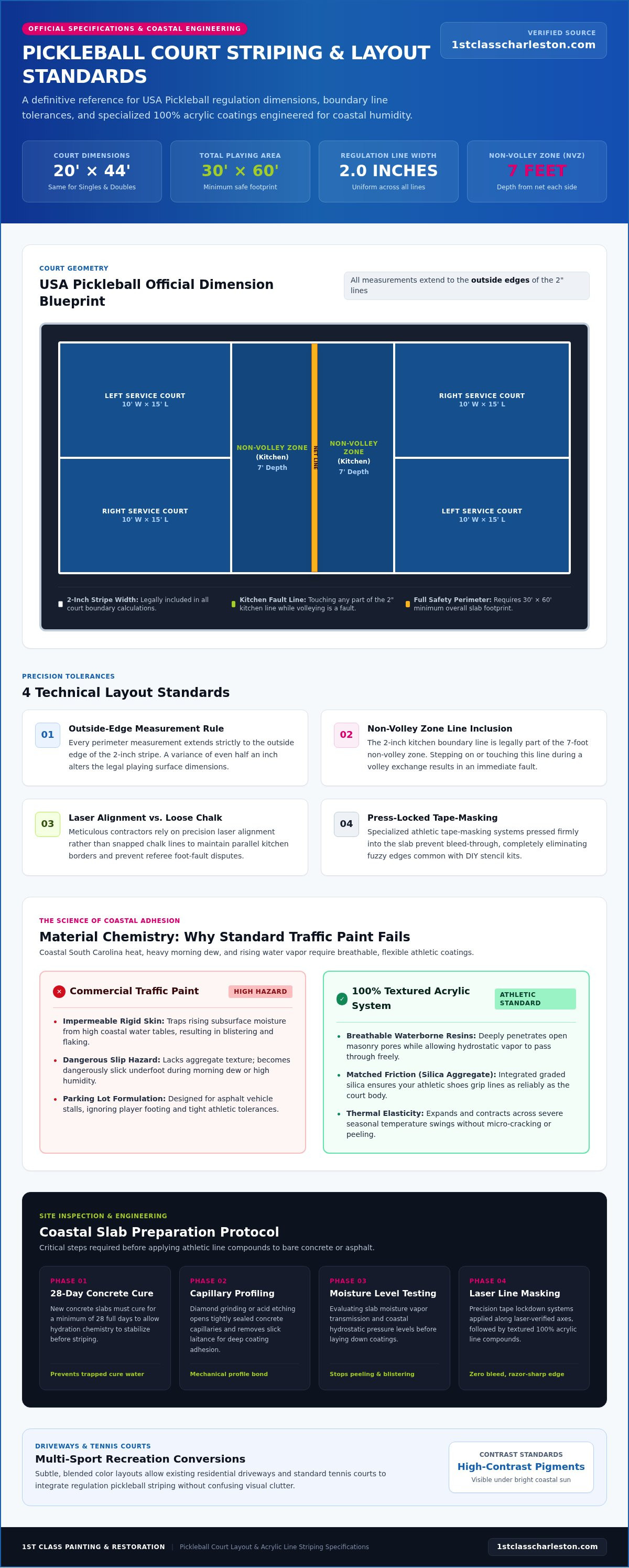
Precision is everything in athletic layout. A regulation USA Pickleball court measures exactly 20 feet wide by 44 feet long, serving both singles and doubles matches on the exact same footprint. Regulation pickleball lines must measure exactly two inches wide throughout the playing area. Unlike some racquet sports, every perimeter measurement extends to the outside edges of the stripes, meaning an accidental half-inch variance alters the legal playing surface. Line placement directly dictates legal boundary calls, baseline integrity, and fair play. Outside the chalk, a player's momentum needs space. A safe, functional layout requires a minimum total playing area of 30 by 60 feet.
Ever since the sport's humble beginnings chronicled in the history of pickleball, uniform court geometry has preserved competitive balance. When exploring professional pickleball court line striping near me, selecting a specialist who respects these tight tolerances guarantees an authentic court that looks immaculate and plays by the official rules.
The Non-Volley Zone: Marking the Critical Kitchen Line
The non-volley zone, commonly known as the kitchen, extends exactly seven feet back from the net on both sides. In USA Pickleball regulations, the line width is legally included within the non-volley zone boundary dimensions. Touching any portion of that two-inch line while volleying results in a fault. Meticulous contractors rely on precision laser alignment rather than snapping loose chalk lines, keeping kitchen borders parallel and eliminating costly foot-fault debates during fast kitchen exchanges.
Centerlines, Sidelines, and Baselines: Visual Contrast and Tolerances
Behind the kitchen line, a crisp centerline splits the backcourt evenly into two ten-foot wide service zones running directly to the baseline. Crisp white or custom high-contrast pigments ensure instant visual clarity against colored court surfaces, even under glaring coastal sunshine. Skilled applicators use specialized tape-masking systems pressed firmly into the slab. This deliberate technique locks down the coating, completely eliminating the fuzzy edges and paint bleeds common with amateur applications.
The Science of Coastal Adhesion: Coatings Built for Lowcountry Humidity
Coastal air presents unique challenges for outdoor surfaces. Heavy morning dews, intense summer heat, and high humidity push standard exterior paints beyond their breaking points. When searching for reliable pickleball court line striping near me, material chemistry matters just as much as layout precision. National striping companies often spray standard commercial traffic paint designed for asphalt parking spaces. On an active game pad, that fast-drying paint forms an impermeable, rigid skin that blisters and flakes when sub-surface moisture rises.
Athletic line coatings require dedicated textured acrylics to prevent dangerous athletic slip-and-fall injuries. Professional sport systems utilize 100% acrylic line compounds specifically engineered for flexibility and breathability. These waterborne resins bond deep into open masonry pores without trapping rising vapors. When planning your court renovation, teaming up with experienced craftsmen who specialize in pickleball court painting ensures your court remains safe, stunning, and resilient across decades of Lowcountry summers.
Moisture Vapor Transmission in Concrete and Asphalt Slabs
High coastal water tables exert hydrostatic pressure against ground-level slabs. Trapped water vapor works upward through porous concrete pores, pushing unbreathable paint films right off the surface. Meticulous professionals tackle this issue by checking slab moisture levels before applying any coating. When working with bare concrete, contractors use diamond grinding or acid etching to open closed capillaries, followed by letting new concrete cure for a full 28 days before striping.
Textured Acrylic Line Compounds vs. Standard Traffic Paints
The difference between commercial lot striping and athletic line marking comes down to texture and elasticity:
- Matched Friction: Athletic line paints integrate fine, graded silica aggregate so your shoe grips boundary lines just as reliably as the open court color.
- Thermal Elasticity: 100% acrylic sport formulations expand and contract with wide temperature swings, eliminating surface micro-cracking.
- UV Defense: Specialized sport pigments resist yellowing and fading under direct southern sun and salty ocean breezes.
Applying smooth parking lot paint creates slick lines that transform wet surfaces into unexpected hazards during aggressive kitchen play. Textured acrylics maintain consistent traction from sideline to baseline.
Professional Court Striping vs. DIY Kits and Parking Lot Stripers
Cardboard stencils and plastic roll-out kits promise an easy afternoon transformation, but the finished results often disappoint. On textured concrete or coarse asphalt, consumer stencils stretch, shift with the wind, and bleed color across aggregate valleys. High-pressure parking lot striping rigs fare no better. Built to blast quick lines between vehicle parking stalls, those heavy machines lack the surgical edge control required for tournament-grade court boundaries. When searching for pickleball court line striping near me, choosing dedicated athletic painters ensures your investment yields crisp, long-lasting boundaries instead of sloppy, feathered lines.
The Tape-and-Seal Method for Zero Paint Bleed
Crisp lines don't happen by accident. Professional court painters apply specialized athletic masking tape using heavy-pressure dual-wheel applicators that mold the tape directly into the slab's textured surface. Rather than brushing line paint right away, experienced crews apply a clear acrylic primer coat along the tape borders. This clear barrier seals microscopic gaps along the edge. Once the white or colored line coating goes down, paint cannot creep underneath, producing razor-sharp edges every single time.
Squaring the Court: The 3-4-5 Triangle Method vs. Laser Alignment
Even a half-inch layout error skews service boxes and baseline depth, frustrating players during close matches. True craftsmen never rely on eyeballed marks or standard tape measures pulled across uneven ground. Instead, technicians combine geometric verification methods like the classic 3-4-5 triangle formula with digital laser alignment tools to cross-check court diagonals. Verifying the exact 48-foot, 4-inch corner-to-corner diagonal measurement guarantees that sidelines and baselines meet at true 90-degree angles. Learn how 1st Class Painting & Restoration delivers exacting athletic court precision for homeowners and recreational facilities throughout the Lowcountry.
Multi-Sport Conversions: Striping Driveways, Slabs, and Tennis Courts
Transforming an underused tennis court or concrete driveway into an active pickleball arena is one of the most effective ways to revitalize recreational space. For homeowners planning a broader backyard entertainment area that combines sport pads with poolside lounging, you can explore Custom Pool Construction and Outdoor Living Installation to see how luxury features harmonize across a property. You don't need to pour a brand-new foundation to join the fastest-growing sport in the country. A single regulation tennis court easily accommodates two, or even four, dedicated pickleball setups. However, success depends on meticulous preparation. Surface patching, leveling low birdbaths, and addressing existing cracks with flexible acrylic repair compounds must occur before laying down court markings. If you are exploring pickleball court line striping near me to adapt an existing surface, proper layout design and line hierarchy ensure every match feels authentic.
Blended Lines: Visual Hierarchy on Shared Tennis Courts
Combining two sports on one court shouldn't create visual chaos. Professional applicators solve this using blended line systems. Tennis boundary lines remain the primary focus in classic, crisp white. Pickleball boundaries are then applied in intentional, secondary shades such as pale sky blues, muted sage greens, or soft athletic yellows. This subtle color contrast establishes a clear visual hierarchy. Tennis players track their primary boundaries without distraction, while pickleball enthusiasts enjoy high-definition lines during fast kitchen exchanges, making neighborhood HOA facilities versatile and dispute-free.
Driveway and Backyard Slab Suitability Requirements
Before rolling out marking tape on a home driveway or patio pad, several site conditions require verification:
- Slope and Drainage: The slab must shed rainwater effectively without exceeding a one percent grade, which can throw off ball bounce and player balance.
- Curing Timelines: Freshly poured concrete requires a minimum 28 to 30 day cure period to prevent trapped chemical moisture from lifting the acrylic coatings.
- Run-Off Clearances: Safe play demands five to ten feet of perimeter clearance beyond the lines to prevent collisions with retaining walls, vehicle bays, or patio steps.
Ready to turn your private driveway or community court into a versatile athletic space? Contact our local painting team to design a customized multi-sport layout tailored to your property.
Hiring a Local Charleston Court Striping Specialist
Every region has its own environmental personality, but coastal South Carolina is truly unique. Salt mist, heavy maritime dew, and sudden afternoon thunderstorms make exterior projects an art of timing. Impersonal national franchises rarely account for these environmental quirks, relying instead on rigid call-center booking schedules. Working with dedicated Lowcountry craftsmen ensures your project is treated with genuine pride and neighborhood care. When evaluating pickleball court line striping near me, an on-site property evaluation is essential. A local specialist inspects slab positioning relative to falling live oak tannins, heavy pine pollen drifts, and shade lines that affect how acrylic resin cross-links under southern sun.
With 23 years of local coastal painting craftsmanship in the Charleston area, the artisans at 1st Class Painting & Restoration bring focused expertise to high-end residential and community sport pads, building durable spaces where families gather with confidence.
The Application Timeline and Curing Process in South Carolina
Durable results demand disciplined patience. The process begins with deep rotary pressure washing and gentle degreasing to lift coastal mold, salt crystals, and surface grime. Once the pad dries completely in the warm coastal air, technicians apply primer seals, hand-tape the grid, and install textured acrylic pigments. While the paint dries to the touch in a few hours, a full 48-hour cure window is essential. This resting period allows the resin polymers to harden fully against aggressive athletic lateral shear.
Maintaining Crisp Lines Against Lowcountry Weather and Sun
Preserving your court's tournament-ready finish takes simple, thoughtful care:
- Routine Rinsing: Wash away fallen live oak leaves and Spanish moss promptly using a standard garden hose to avoid organic acid staining.
- Mindful Cleaning: Steer clear of high-pressure wand tips or aggressive industrial solvents aimed right along taped paint borders.
- Periodic Recoating: Schedule a professional visual review and precision restriping every three to five years to keep edges bright and slip-resistant.
Investing in skilled local hands ensures your recreation space remains a radiant centerpiece for friendly competition and outdoor Lowcountry living. When budgeting for property prep or ongoing outdoor upkeep, it can be helpful to explore Project-based labor and maintenance fees to understand how professional repair work is structured.
Creating an authentic playing experience comes down to strict USA Pickleball geometry, textured breathable acrylics, and meticulous edge sealing that stops paint bleed in its tracks. Cutting corners with DIY kits or generic road stripers leads to slippery surfaces, peeling paint, and constant out-of-bounds disputes. When searching for reliable pickleball court line striping near me, you deserve dependable footing and crisp boundaries that hold up against coastal heat and moisture.
With 23 years serving the greater Charleston community, our dedicated local painters understand coastal humidity demands and apply specialized sport court surface and striping coatings built for long-term performance. Whether you are revitalizing an existing neighborhood tennis slab or adapting a private driveway, true craftsmanship turns your recreational area into an inviting centerpiece. Request a court painting consultation with 1st Class Painting & Restoration today, and get ready to enjoy countless memorable matches right in your own backyard!
Frequently Asked Questions
Can you paint pickleball lines directly onto a standard concrete driveway?
Yes, you can paint lines onto an existing driveway if the concrete is clean, sound, and properly prepared. Professional applicators first degrease the slab and test moisture levels before etching or mechanically profiling the concrete. If you are researching pickleball court line striping near me for a residential driveway, verify that the slope doesn't exceed a one percent pitch to keep ball bounces true and prevent water accumulation.
How wide are official regulation pickleball court lines supposed to be?
Official USA Pickleball regulation lines must measure exactly two inches wide throughout the court layout. This standard applies to the baselines, sidelines, centerlines, and the non-volley zone lines. All court boundary dimensions are measured to the outside edges of these two-inch stripes. Maintaining this precise width ensures accurate in-bounds calls and consistent kitchen fault rulings during competitive or casual matches.
What is the difference between parking lot paint and athletic court line paint?
Athletic court line paint contains graded silica aggregate and breathable 100 percent acrylic resins, whereas parking lot traffic paint forms a slick, impermeable film. Commercial traffic coatings lack surface friction, creating dangerous slip hazards under athletic footwear during quick directional changes. In contrast, specialized sport court line paints provide matching texture underfoot while allowing sub-surface moisture to pass through safely without blistering or peeling.
How long does professional pickleball court line striping take to cure?
Professional athletic acrylic line coatings generally dry to the touch within two to four hours on a clear, sunny day. However, a full 48-hour cure window is required before opening the court for active play. Allowing the coating to cross-link completely ensures the paint withstands the intense lateral shear, scuffing, and sudden stops typical of aggressive competitive footwork.
Can pickleball lines be added to an existing tennis court without ruining it?
Yes, pickleball lines can be seamlessly blended onto an active tennis court using secondary color pigments. Experienced sport painters apply muted tones like soft blue, gray, or pale yellow rather than stark white. This visual hierarchy preserves the visual dominance of the original white tennis boundaries while clearly distinguishing the pickleball court for players, making neighborhood courts versatile without confusing line clutter.
Why does paint peel off outdoor concrete slabs in coastal South Carolina?
Paint primarily peels in the Lowcountry due to high water tables driving moisture vapor up through concrete pores. Charleston's extreme summer humidity and heavy rainfall create hydrostatic pressure beneath non-breathable paints. When property owners book pickleball court line striping near me, choosing a local Charleston contractor who uses vapor-permeable, 100 percent acrylic sport coatings prevents the blistering and premature delamination caused by coastal groundwater.
How much space is needed around the court lines for safe play?
A safe pickleball layout requires a minimum total envelope of 30 feet wide by 60 feet long, even though court boundaries measure 20 by 44 feet. This buffer provides five feet of run-off space along sidelines and eight feet behind baselines. Adequate perimeter room prevents serious collisions with garage walls, fences, light poles, or patio edges during fast-paced, high-momentum rallies.


